
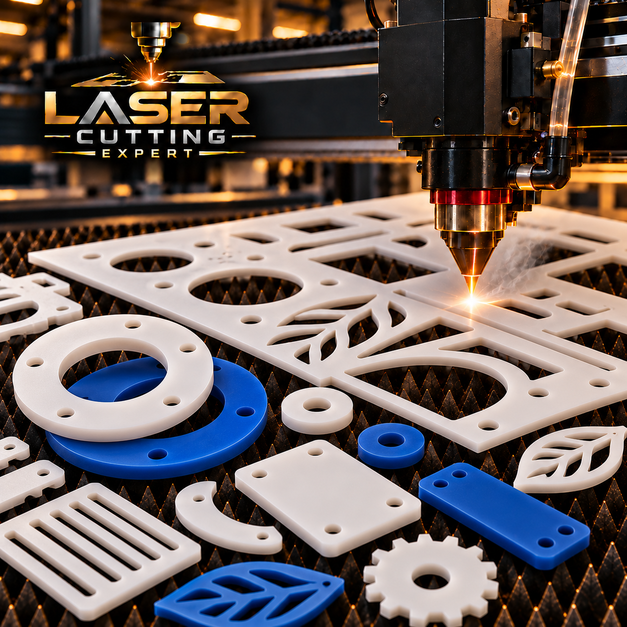
Plastic is not one material, so the first question before we laser cut plastic is always: what polymer is it? Different plastic sheets can look almost identical while reacting very differently to laser heat. At Laser Cutting Expert, we provide plastic laser cutting services from our London workshop for suitable, identified materials used in prototypes, templates, stencils, packaging components, panels, spacers, product parts and display work. Customers can provide their own sheet where its composition is known, or we can source an appropriate material. We handle one-offs and production quantities with no minimum order, with fast London and UK-wide delivery options available.
CALL OR EMAIL US FOR PRICES
“Order any time of the day or night and receive your order on the same day in London. You are welcome to visit our laser cutting shop for an instant laser cutting service. On-site collection or free delivery can be arranged. Email us at laser@makergroup.uk for a quick quote or call us on 02036339857 for an instant price”.
Same Day Laser Cutting & Delivery
We can arrange a same day courier delivery with customer live tracking. Or customers can collect from our Laser Cutting Expert shop.

OPEN 24 HOUR
We are open 7 days a week, and you can order at any time. There is no last ordering time and no deadline. We also offer an overnight laser cutting service.
100% Satisfaction
High Quality Laser Cutting & 100% Customer Satisfaction Guarantee. Top-Rated Laser Cutting Company on Google.

Free File Check
We offer a free file check and proof before sending your artwork for laser cutting.
Plastic Identification Comes Before Cutting
We do not treat an unknown plastic sheet as safe simply because it appears suitable for a laser. Before plastic sheet laser cutting, the polymer type, thickness, coating and any available manufacturer information should be confirmed. Some plastics cut successfully, some produce poor edges or excessive melting, and others should never enter a laser machine because heating them can release hazardous or corrosive gases. PVC and chlorine-containing vinyl are examples we will not laser cut. Unknown customer-supplied sheets may require a material specification or safety data before acceptance. This material-first approach protects the equipment, working environment and finished component while helping us choose a genuinely suitable manufacturing process.
Plastic Sheet Laser Cutting for Custom Components
For compatible materials, laser cut plastic sheets provide a practical starting point for custom profiles without dedicated dies or physical cutting tools. CAD-controlled cutting can create external shapes, internal openings, slots, holes and repeated parts across the sheet. Products may include templates, packaging inserts, equipment labels, separators, spacers, display components, craft shapes, model parts, product prototypes and lightweight panels. With plastic sheet laser cutting, several related components can also be nested together to make better use of the material. Sheet dimensions, thickness, flatness and thermal behaviour are considered before production because these factors affect both cutting performance and the way the finished part behaves afterwards.
Polypropylene Laser Cutting
Requests to laser cut polypropylene need to be assessed around the exact sheet specification and intended product. Polypropylene is lightweight, flexible and resistant to many everyday chemicals, which makes it useful for certain templates, packaging components, folders, separators and prototype parts. However, heat can influence the cut edge and fine geometry, so it should not be approached in the same way as rigid acrylic. Thin bridges, tiny holes and closely spaced cuts may behave differently depending on thickness and grade. Where polypropylene is appropriate for the intended process, we review the design and material first and can produce a sample before moving into a larger batch of components.
Polycarbonate Requires a Different Approach
Customers often ask whether we can laser cut polycarbonate, particularly for guards, covers, panels and engineering components. Polycarbonate needs caution because laser processing can produce discoloured, melted or otherwise poor-quality edges, especially as thickness increases, and it is often better suited to another cutting method. We therefore assess the specific grade and thickness instead of automatically accepting it for laser cutting. Where laser processing is unsuitable, another manufacturing route should be used. This is an important difference between a genuine plastic cutting service and simply putting every plastic into the same machine. Material suitability always comes before the convenience of a particular cutting process.
ABS Laser Cutting and Material Suitability
ABS laser cutting is another request that needs careful material assessment. ABS can react poorly under laser heat, producing melting, smoke and undesirable fumes, so we do not treat it as a routine laser-cutting material. If an ABS component is required, send us the drawing, thickness and material information first so the correct manufacturing approach can be considered. Typical ABS-type requirements include prototype housings, covers, equipment components, spacers and product-development parts, but the desired product does not mean laser cutting is automatically the correct process. Where a plastic is not appropriate for laser processing, we would rather recommend a different suitable cutting method than force the job through a laser.
Mylar Stencils, Templates and Reusable Patterns
Laser cut mylar is commonly associated with stencils and reusable templates because thin suitable polyester film can hold detailed patterns while remaining lightweight and flexible. Applications can include lettering stencils, logo stencils, painting templates, craft patterns, marking guides and repeated decorative designs. Stencil artwork needs particular attention because enclosed areas inside letters such as A, B, D, O, P and R require bridges to keep their centres connected. Bridge width should be appropriate for the material and expected use. Our existing laser cut stencil and template products can therefore be adapted for branding, decorating, workshops, craft projects and other repeated marking applications where the confirmed film is laser compatible.
PETG Cutting, Etching and Prototype Applications
Requests to laser cut PETG should be reviewed using the exact material grade, thickness and required result. PETG has different thermal behaviour from acrylic and may not produce the same clear, polished-looking edge under laser processing. Heat can influence the edge and surface, so sample testing can be valuable where appearance matters. PETG laser cutting and etching requirements should therefore be discussed before a production quantity is approved, particularly for visible components. PETG is used for displays, covers, packaging, prototypes and formed components, but another cutting or marking process may sometimes give a more appropriate result depending on thickness and finish expectations.
Plastic Components for Prototypes and Product Development
Plastic cutting is particularly useful during development because designers often need physical parts before committing to tooling or full production. Suitable laser cut plastic components can include templates, spacers, dividers, test panels, display pieces, model parts, packaging inserts and assembly aids. A prototype allows hole positions, dimensions and overall geometry to be checked against the real product. Changes can then be made to the CAD file before additional components are manufactured. This workflow suits students, engineers, product designers, start-ups and established manufacturers. There is no requirement to order a large quantity, so one experimental component can be produced where the chosen material is confirmed as suitable for laser processing.
Stencils, Templates and Workshop Aids
Many useful plastic products are simple tools rather than finished retail items. Suitable films and sheets can be turned into drilling templates, positioning guides, painting stencils, alignment tools, shape templates and workshop aids. These products benefit from repeatable digital geometry because the same holes or outlines can be reproduced without repeatedly measuring by hand. Laser cut mylar is particularly relevant to stencil work, while other confirmed laser-compatible plastics may suit different templates. Our related Precision & Fine Detail Laser Cutting service can be useful where the artwork contains detailed patterns or small features. Material choice still depends on flexibility, thickness, durability and the environment where the template will be used.
Packaging Inserts, Dividers and Organising Components
Suitable plastic sheet can also be useful for packaging and organisation. Depending on material compatibility, we can manufacture separators, product dividers, internal packaging shapes, lightweight trays or flat inserts, identification pieces and organising components. These may be supplied as individual profiles or as sets designed around a particular product. With laser cut plastic sheets, several sizes can be nested on one sheet, which is useful when a packaging system requires different shapes in the same order. Slots and tabs should be designed around the measured sheet thickness when parts interlock. If the material needs heat forming afterwards, that requirement should also be considered before the flat profiles are produced.
Plastic Panels, Guards and Covers
Panels, machine covers and protective components are frequently specified in plastics, but their function determines which material and process should be used. A decorative panel has very different requirements from an impact-resistant machine guard. For that reason, material selection should be made by the responsible designer or engineer where safety or impact resistance matters. Requests to laser cut polycarbonate, for example, should not be accepted automatically simply because polycarbonate is widely used for guards. We first consider whether laser cutting is appropriate for the specified sheet. Suitable laser-compatible plastics can then be processed into panels, inspection templates, covers and display components where their properties match the intended use.
Laser Cutting Plastic Tube
Laser cutting plastic tube is different from cutting a flat plastic sheet because the component has a curved surface and must be controlled around its diameter. Material composition is again the first consideration. Not every plastic tube is safe or suitable for laser processing, and unidentified tube should not be assumed compatible. Where an appropriate material and tube-cutting process are available, requirements may include openings, slots, profile cuts or other custom features. Diameter, wall thickness, tube length and cut geometry all affect feasibility. Customers should therefore provide the tube specification and drawing so we can assess the job before confirming the appropriate production method or recommending an alternative.
Heat Behaviour, Edges and Small Features
Plastic can soften, melt, discolour or deform when heated, and the extent depends heavily on the polymer. This makes heat behaviour a major part of plastic laser cutting services. Very small holes, narrow slots and closely spaced profiles may concentrate heat, while thin components can move during processing. A material that cuts acceptably in a simple outside profile may behave differently when the design contains hundreds of small openings. We therefore look at geometry together with thickness and polymer type. When edge appearance or dimensional fit is particularly important, producing a sample can establish what the real sheet does before an entire batch of panels, templates or product components is processed.
Expert Technical Overview – Plastic Laser Cutting
Professional plastic sheet laser cutting starts with positive material identification. Polymer type, thickness, additives, coatings and thermal behaviour determine whether laser processing is suitable at all. Laser cut polypropylene, laser cut mylar and laser cut PETG requirements can each behave differently, while laser cut polycarbonate and ABS laser cutting may be unsuitable or produce poor results depending on specification. PVC and chlorine-containing vinyl must not be laser cut because hazardous and corrosive gases can be generated. Unknown plastics require confirmation before processing. For suitable materials, kerf, heat, feature spacing and edge behaviour should be tested when dimensional fit or appearance is important.
Customer-Supplied Plastic and Unknown Materials
Customers are welcome to provide their own plastic, but we need to know what it is before accepting it for laser processing. A manufacturer’s product name, polymer code, technical specification or safety data sheet can help establish suitability. Appearance alone is not enough because two transparent, white or black sheets may be completely different polymers. We will not laser cut unidentified material where its composition cannot be confirmed. This is particularly important for vinyl and other materials that may contain chlorine. If the supplied sheet is unsuitable, we can discuss sourcing an alternative or using another manufacturing process rather than risking unsafe fumes, equipment corrosion or an unacceptable finished edge.
Same Day Plastic Cutting in London
Our London workshop operates 24/7, including weekends and bank holidays, which allows suitable urgent plastic jobs to be considered outside normal production hours. Same-day cutting and courier delivery across London can be available when the material has been identified, the design is production-ready and the required process is appropriate. Typical urgent requirements include templates, stencils, replacement panels, prototype components, packaging inserts, display pieces and event parts. There is no minimum quantity, so customers can order one prototype as easily as a repeat batch. For customers elsewhere in the UK, suitable completed work can be dispatched for next-day delivery once production and any required finishing are complete.
Plastic Laser Cutting Near Me
If you are searching for plastic laser cutting near me, Laser Cutting Expert provides production from London while accepting orders from throughout the UK. Send us the CAD file or artwork together with the material name, thickness, dimensions and quantity. If you are supplying your own plastic, include its technical information so we can check whether it is suitable for laser processing. Our team can also help prepare a production-ready drawing where required. We handle one-offs, prototypes, short runs and repeat orders, and suitable London projects can use same-day courier delivery. UK customers can receive completed work through our next-day delivery options where production timing permits.
FAQs About Plastic Laser Cutting
1. What plastics can you laser cut?
It depends on the exact polymer, thickness, additives and coatings. We confirm material compatibility before production rather than treating all plastics as suitable.
2. Can you laser cut polypropylene?
We can assess requests to laser cut polypropylene based on the exact grade, thickness and required result. Sample testing may be recommended for some projects.
3. Can you laser cut polycarbonate?
Laser cut polycarbonate requests require careful assessment because laser processing can cause poor edge quality, melting and discolouration. Another cutting process may be more suitable.
4. Do you offer ABS laser cutting?
ABS laser cutting is not treated as a routine laser process because of its behaviour under heat and the fumes it can produce. We assess the material and may recommend another cutting method.
5. Can you cut Mylar stencils?
Yes, suitable confirmed polyester film can be used for laser cut mylar stencils and templates. The artwork must include suitable bridges where required.
6. Do you cut PVC or vinyl plastic?
We do not laser cut PVC or chlorine-containing vinyl because heating these materials can generate hazardous and corrosive gases.
7. Can I bring my own plastic sheet?
Yes, but its composition must be known and suitable for laser processing. Please provide the material specification or manufacturer information where possible.