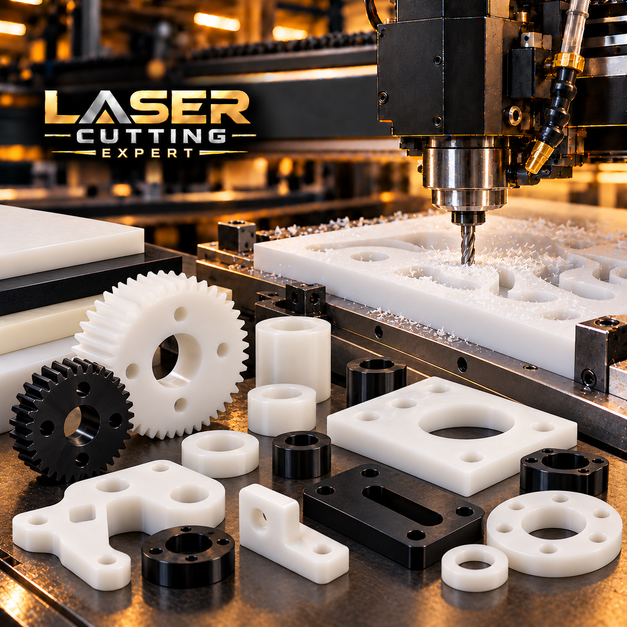
Specialist materials should never be grouped together simply because they arrive as sheets. Acetal is an engineering thermoplastic, peel ply is normally a woven process material used during composite manufacture, and quartz can describe several very different mineral or engineered products. Each needs its own assessment before cutting begins. Laser Cutting Expert handles specialist material enquiries from our London workshop for engineers, manufacturers, composite businesses, designers, laboratories, students and product developers. Our work includes assessment for laser cutting acetal, suitable laser cut peel ply components and projects involving quartz laser cutting enquiries. Where laser processing is unsuitable, we would rather identify that early and recommend a more appropriate manufacturing route.
CALL OR EMAIL US FOR PRICES
“Order any time of the day or night and receive your order on the same day in London. You are welcome to visit our laser cutting shop for an instant laser cutting service. On-site collection or free delivery can be arranged. Email us at laser@makergroup.uk for a quick quote or call us on 02036339857 for an instant price”.
Same Day Laser Cutting & Delivery
We can arrange a same day courier delivery with customer live tracking. Or customers can collect from our Laser Cutting Expert shop.

OPEN 24 HOUR
We are open 7 days a week, and you can order at any time. There is no last ordering time and no deadline. We also offer an overnight laser cutting service.

100% Satisfaction
High Quality Laser Cutting & 100% Customer Satisfaction Guarantee. Top-Rated Laser Cutting Company on Google.

Free File Check
We offer a free file check and proof before sending your artwork for laser cutting.
Start with the Material Name, Not Its Appearance
Two white plastic sheets can look almost identical while being made from completely different polymers. The same problem occurs with fabrics, composites and mineral-based materials. Before accepting specialist cutting work, we need to know exactly what the customer has supplied. Manufacturer, grade, thickness, reinforcement, coating and safety information can all matter. This is especially important for laser cutting acetal and unfamiliar engineering plastics because material composition determines how the sheet responds to heat. Unknown material should not be identified simply by appearance. Where available, a technical data sheet or safety data sheet gives us a much better starting point for deciding whether laser processing should be considered.
Acetal as an Engineering Plastic
Acetal, also known in many applications as POM, is valued for dimensional stability, low friction and good mechanical properties. It is commonly encountered in engineering environments rather than purely decorative work. However, laser cutting acetal needs careful process and fume consideration because thermal processing can create undesirable decomposition products, including formaldehyde-containing fumes. We therefore assess the exact material and application before agreeing to a production route and do not treat acetal like acrylic. Depending on thickness, tolerance, edge requirement and component function, CNC machining or another mechanical process may be preferable. Material identification and an understanding of the finished component always come before choosing the cutting technology.
Acetal Components and Engineering Profiles
Where an appropriate manufacturing process has been established, acetal can be used for spacers, guides, wear components, plates, insulators, washers and custom engineering profiles. Enquiries for laser cutting acetal often begin with a flat CAD drawing containing outside profiles, holes and slots. The important question is whether laser processing can deliver the edge and dimensional result required for that particular part. Heat-sensitive tolerances or mechanically demanding features may favour machining instead. Engineers should therefore identify critical dimensions rather than applying unnecessarily tight tolerances to every feature. If a component will carry load, interact with moving machinery or perform a safety-related function, the responsible engineer must validate its material and final manufacturing method.
Acetal Washers, Spacers and Separators
Flat washers and spacers are common engineering shapes because they can be defined easily in two dimensions. Acetal may be selected where low friction, electrical isolation or separation between components is useful. When customers enquire about laser cutting acetal for these parts, we review material thickness, hole diameter, outside dimensions and required edge condition before deciding whether the laser is appropriate. Very small holes or tight-fitting mechanical features may require machining to achieve the required result. For prototypes, a small quantity can be useful for checking assembly before further production. There is no minimum order, so customers do not need to commit to a large batch simply to test a component.
Acetal Plates and Equipment Components
Engineering equipment may use flat acetal plates for mounting, guiding, separating or supporting other components. CAD files can contain mounting holes, slots and custom outside geometry, but the final process should be selected around function rather than convenience. Laser cutting acetal may not be appropriate where thermal edge effects could interfere with a precision fit or where the component requires machining-quality surfaces. We assess those factors before production. Components used around food equipment, medical systems or regulated machinery also require appropriate material certification and product-level validation from the responsible manufacturer. Cutting a specified polymer accurately does not itself establish regulatory suitability for the completed equipment.
Why Acetal Should Not Be Treated Like Acrylic
Acrylic is widely associated with clean laser-cut edges, which can lead customers to assume that all rigid plastics will respond similarly. They do not. Laser cutting acetal involves a completely different polymer and different thermal behaviour. Acetal can melt and thermally decompose, and fumes produced during processing require serious consideration. A design that cuts successfully from acrylic may therefore need another manufacturing route when changed to acetal. The final application also matters: a decorative acrylic panel and a precision acetal machine component have very different edge and tolerance expectations. We select the process around the real material and functional requirement rather than using a single plastic cutting approach.
Customer-Supplied Acetal Sheet
Customers are welcome to discuss their own engineering sheet with us, but identification is essential before any laser cutting acetal work is considered. Ideally, provide the manufacturer’s name, exact product or grade, thickness and technical or safety documentation. We do not rely on a handwritten label saying plastic or acetal when the original specification is unknown. Engineering plastics can contain additives or belong to related material families that require different processing decisions. If laser processing is unsuitable, another method such as CNC routing or machining may provide a better result. Confirming this before production helps prevent damaged material, poor components and unnecessary exposure to hazardous thermal decomposition products.
Peel Ply Is a Process Material
Peel ply is normally used during composite manufacturing rather than as the final structural laminate itself. It can be placed against resin during lay-up and removed after cure to leave a prepared surface for later bonding or finishing. Requests for laser cut peel ply pieces therefore need to consider the exact textile composition and whether the material contains coatings or other treatments. Nylon and polyester peel plies, for example, should not automatically be assumed to behave identically. The supplier specification should be checked before processing. Cutting accuracy can help prepare repeatable shapes for composite production, but the composite manufacturer remains responsible for confirming that the selected peel ply is appropriate for the resin system and process. Our related Automated & Robotic Laser Cutting service can support suitable projects where automation or multi-axis processing forms part of the manufacturing route
Peel Ply Shapes for Composite Lay-Up
Composite workshops may need repeated peel-ply pieces for panels, moulded parts, repairs or prototype laminates. Preparing these manually can take time when the same shape appears repeatedly. Suitable laser cut peel ply patterns could include circular pieces, rectangular panels, openings and more complex outlines based on digital templates. Before processing, we need to confirm fibre composition, coatings and any other relevant product information. The cutting method must not be assumed suitable merely because the material is thin. Where a laser-compatible peel ply is established, digital patterns can help improve repeatability between lay-ups. Customers can order prototypes or small batches before introducing the pieces into a larger composite production workflow.
Composite Manufacturing Templates
Composite production involves more than carbon fibre itself. Peel ply, breather materials, release layers, fabrics and other consumables can all need shaping before lay-up. A laser cut peel ply component can follow the same digital geometry used for other production templates, helping the workshop organise repeat builds. However, each consumable should be assessed independently because different polymers and coatings respond differently to heat. A cutting method suitable for one layer may be unsuitable for another. Composite manufacturers should provide supplier information rather than grouping all flexible process materials together. Where laser processing is not appropriate, mechanical or dedicated textile-cutting methods may be recommended instead.
Peel Ply for Prototype Composite Parts
Prototype composite work often changes quickly. A panel may be resized, an opening moved or a mould modified between development versions. Digital laser cut peel ply patterns can be useful for suitable materials because the geometry can be changed without creating a permanent physical die. This is particularly helpful for research, motorsport development, product design and small composite workshops producing short runs. The customer should still verify the peel ply type and compatibility with the resin and cure process. Laser Cutting Expert manufactures the specified profile where appropriate, but composite lay-up quality, cure cycle, structural performance and bonding preparation remain under the control of the responsible composite manufacturer or engineer.
Quartz Is Not One Simple Cutting Material
The word quartz can refer to natural quartz, fused quartz, quartz glass or engineered stone containing quartz particles and resin. These materials have very different properties, so quartz laser cutting cannot be discussed as one universal process. A method that affects thin fused quartz may have little relevance to a thick engineered kitchen worktop. Thermal stress, cracking, resin content and required edge quality all need consideration. For many quartz products, conventional stone-processing equipment, diamond tooling, waterjet or another specialist method can be more appropriate than laser cutting. We therefore begin quartz enquiries by establishing exactly what the material is and what finished result the customer needs.
Fused Quartz and Technical Applications
Fused quartz is used in specialist optical, laboratory, semiconductor and high-temperature applications because of its particular thermal and optical properties. Enquiries about quartz laser cutting for this type of material need detailed information about thickness, purity, dimensions and edge requirements. Precision technical quartz processing can require specialised laser systems or other dedicated manufacturing methods beyond general sheet-cutting equipment. We therefore assess the job rather than promising that every fused quartz component can be produced using our standard laser process. For laboratory or optical components, tolerances and surface requirements should be specified clearly because the appropriate manufacturing route may involve specialist machining, polishing or finishing in addition to profile cutting.
Engineered Quartz and Stone Products
Engineered quartz used for worktops and interior surfaces is normally a composite containing mineral particles combined with resin and other ingredients. That construction is very different from fused quartz. Standard quartz laser cutting should not automatically be assumed suitable for these products because heat can affect the resin and create poor edges or hazardous emissions. Thick stone products also require a cutting technology capable of producing controlled profiles without unacceptable cracking or thermal damage. Waterjet, bridge saws and diamond tooling are commonly more appropriate categories of process to investigate. Customers should provide the exact product specification so the correct production route can be identified before valuable material is processed.
Quartz Shapes for Design Projects
Designers sometimes approach us with drawings for quartz circles, panels, decorative shapes or inserts and ask whether they can simply be laser cut like acrylic. The answer depends entirely on the material. Quartz laser cutting may describe specialist processing in some industries, but it is not automatically the best method for decorative stone or thick quartz-based products. Edge appearance, thickness and risk of cracking all influence process selection. If the design can be prototyped first in acrylic, plywood or another suitable sheet, that can sometimes help confirm geometry before the final quartz component is commissioned through an appropriate specialist process. This reduces the risk of discovering design problems in expensive material.
Specialist Materials Need Test Pieces
A known material with an established production history is very different from an unfamiliar specialist sheet supplied for the first time. Small test pieces allow edge behaviour, heat response and dimensional results to be reviewed before an entire sheet is committed. This can be particularly useful when assessing laser cutting acetal or a suitable laser cut peel ply material. A successful test does not automatically establish suitability for every thickness or application, but it provides useful evidence for the specific project. Where the test shows excessive melting, decomposition, charring or another unacceptable result, we can stop before valuable material is wasted and discuss whether another cutting technology makes more sense.
Safety Data Sheets Help Us Make Better Decisions
A safety data sheet does not tell us everything about cutting performance, but it can identify important ingredients, decomposition hazards and handling requirements. For unfamiliar polymers, composite consumables and engineered materials, this information can determine whether laser processing should even be considered. We may request documentation before laser cutting acetal, processing coated fabrics or assessing other specialist products. Similar caution applies to quartz laser cutting enquiries involving resin-bound engineered stone. Unknown materials should never be tested casually just to see what happens under heat. Material identification is part of responsible production and protects the customer, workshop team, extraction system and laser equipment.
PVC and Chlorinated Materials Are Excluded
Some specialist sheets, flexible materials and composite consumables can look harmless while containing PVC or other chlorine-bearing compounds. These must not be laser cut because heating them can release hazardous and highly corrosive gases. This rule applies regardless of whether the customer needs one prototype or a large production batch. When assessing a laser cut peel ply or unfamiliar engineering material, we therefore need to understand the actual composition rather than relying on appearance. If a supplier cannot confirm what a material contains, we may decline laser processing and recommend another cutting method. Unknown composition is a production risk, not simply an inconvenience.
Tolerances Should Match the Process
Specialist engineering components often arrive with drawings containing tight tolerances on every dimension. In practice, not every feature needs machining-level precision. When considering laser cutting acetal, we review which holes, slots and profiles are genuinely critical to the assembly. If a bearing fit, precision bore or close mechanical interface is required, machining may be more appropriate for that feature or for the entire component. Other outside profiles may have more generous requirements. Separating functional tolerances from general dimensions helps select a sensible manufacturing route. The same principle applies across specialist materials: the best process is the one that meets the actual design requirement rather than the one chosen first.
Prototypes Before Specialist Production
One-off development work is common with unusual materials because designers may not yet know exactly how the final component will behave. Our no-minimum-order approach allows suitable projects to begin with a prototype rather than a full batch. A trial involving laser cutting acetal can reveal whether another process would better suit the required edge or tolerance. A laser cut peel ply sample can help a composite workshop check fit against its mould or laminate. For quartz laser cutting enquiries, an inexpensive prototype in another material can sometimes verify the geometry before specialist quartz manufacturing begins. Early testing helps separate design problems from material-processing problems.
CAD Support for Unusual Materials
Customers do not always arrive with a production-ready file. Some have a sketch, dimensions, a physical sample or an early CAD model that still needs preparation. We can help organise suitable two-dimensional cutting geometry and identify areas that may create manufacturing problems. With laser cutting acetal, for example, very small features may need reconsideration depending on the chosen process. A laser cut peel ply pattern may need simplified corners or registration features for easier lay-up. Quartz designs may need modification if another manufacturing technology is selected. Designing with the intended process in mind generally produces better results than completing the drawing first and thinking about manufacturing afterwards.
Choosing Laser, CNC or Another Cutting Method
Our job is not to force every project onto a laser. A laser is excellent for many sheet materials, but specialist materials often benefit from other technology. Laser cutting acetal may be rejected in favour of CNC machining when edge quality, fumes, thickness or mechanical tolerances make machining more appropriate. A suitable laser cut peel ply job might work well when composition is confirmed, while another composite consumable may require a blade-based process. Quartz laser cutting may need dedicated specialist equipment, or waterjet and diamond tooling may be the better route. Process selection should follow material behaviour and finished-part requirements rather than a preferred machine.
Technical Review for Specialist Material Cutting
Acetal, peel ply and quartz demonstrate why “material cutting” is not a single process. Acetal is a thermoplastic whose thermal decomposition and fumes require careful consideration. Peel ply is a composite-manufacturing consumable whose fibre and coating need identification. Quartz may be mineral, glass-like or resin-bound, changing the manufacturing problem completely. Before laser cutting acetal, producing laser cut peel ply components or evaluating quartz laser cutting, we consider material specification, thickness, geometry, edge requirement and final use. Safety-critical or regulated finished parts require separate validation by the responsible manufacturer or engineer. Where laser processing is inappropriate, we will say so rather than overstate its capability.
Same Day Specialist Cutting Assessment London
Urgent prototypes sometimes involve materials that cannot responsibly be accepted without checking what they are. Our London workshop operates 24/7, including weekends and bank holidays, so we can review suitable urgent enquiries quickly, but same-day production depends on confirmed material compatibility. Projects involving laser cutting acetal, laser cut peel ply requirements or quartz laser cutting questions should include material specifications wherever possible. Once an appropriate process has been established, suitable work may be produced and delivered across London on the same day. There is no minimum order. For customers elsewhere in the UK, next-day delivery options are available for suitable completed components depending on production requirements.
Specialist Material Cutting Across the UK
Laser Cutting Expert works with engineers, composite manufacturers, laboratories, designers, universities, product developers and industrial businesses throughout the UK. Send us your drawing, material name, manufacturer information, thickness, quantity and intended application. We can assess laser cutting acetal, suitable laser cut peel ply projects and quartz laser cutting enquiries without assuming the same process fits all three materials. Customers can provide their own materials, although unfamiliar products may require technical documentation before acceptance. Design support is available where the drawing still needs preparation. Our London production team handles prototypes, development pieces and repeat components, with nationwide delivery available for suitable completed work.
FAQs About Acetal & Specialist Material Cutting
1. Can you laser cut acetal?
We assess laser cutting acetal carefully because thermal processing can cause melting and decomposition fumes, including formaldehyde-containing emissions. Depending on the part, CNC machining may be more appropriate.
2. Can you cut peel ply into custom shapes?
Potentially. A laser cut peel ply project requires confirmation of the textile composition, coatings and other material information before laser processing is approved.
3. Can you laser cut quartz worktops?
Standard quartz laser cutting is generally not something to assume suitable for engineered quartz worktops. Waterjet, saw or diamond-based processes may be more appropriate.
4. What information should I provide for an unusual material?
Please send the manufacturer, material name or grade, thickness, technical data or SDS where available, quantity and intended application.
5. Can you test my material first?
Yes, where the material is identified and safe to process, a small test may be considered before committing the full sheet.
6. Do you cut unidentified plastics?
No. Unknown plastics can contain substances unsuitable or unsafe for laser processing. Material identification is required.
7. Is there a minimum order?
No. Suitable specialist work can begin with one prototype or test component before moving into short-run or repeat production.