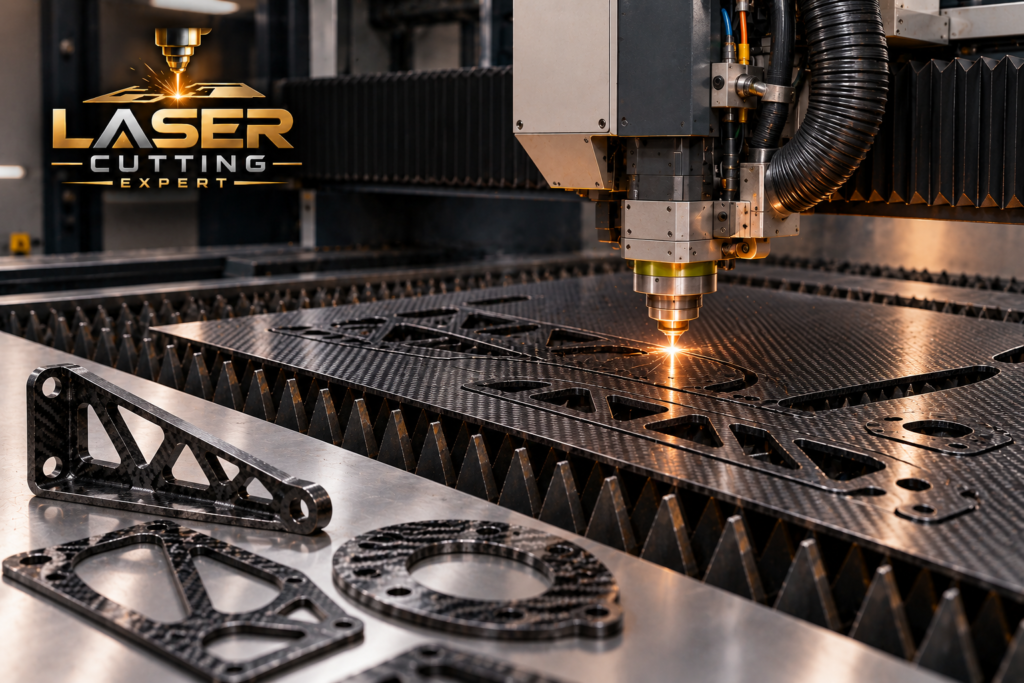
Carbon fibre needs to be identified before anyone decides how it should be cut. Dry woven cloth, prepreg and a fully cured carbon-fibre laminate may all be described as “carbon fibre”, but they are very different materials once heat is introduced. At Laser Cutting Expert, we assess carbon fibre laser cutting projects from our London workshop for designers, engineers, manufacturers, students and product developers. Suitable work may include development samples, lightweight panels, prototype profiles, decorative components, templates and composite manufacturing pieces. There is no minimum order. Customers can send their own identified material and technical information, while suitable urgent projects can be considered for same-day London service.
CALL OR EMAIL US FOR PRICES
“Order any time of the day or night and receive your order on the same day in London. You are welcome to visit our laser cutting shop for an instant laser cutting service. On-site collection or free delivery can be arranged. Email us at laser@makergroup.uk for a quick quote or call us on 02036339857 for an instant price”.
Same Day Laser Cutting & Delivery
We can arrange a same day courier delivery with customer live tracking. Or customers can collect from our Laser Cutting Expert shop.

OPEN 24 HOUR
We are open 7 days a week, and you can order at any time. There is no last ordering time and no deadline. We also offer an overnight laser cutting service.

100% Satisfaction
High Quality Laser Cutting & 100% Customer Satisfaction Guarantee. Top-Rated Laser Cutting Company on Google.

Free File Check
We offer a free file check and proof before sending your artwork for laser cutting.
Start with the Carbon Fibre Construction
The first question is not simply how thick the carbon fibre is. We need to know how it has been manufactured. Dry carbon cloth consists primarily of reinforcement fibres, while prepreg contains a controlled resin system and cured carbon-fibre sheet has already been consolidated into a rigid composite. Backing films, adhesives, surface coatings and hybrid reinforcement may also be present. These differences affect cutting behaviour, fumes, edge condition and whether laser processing is appropriate at all. For that reason, unknown carbon composite material is not treated as ordinary sheet. Supplier specifications or safety data should be provided where possible before we decide whether a particular carbon fibre job can be processed safely.
Dry Carbon Fibre Fabric
Dry woven carbon fibre is flexible and should be treated as a textile reinforcement rather than as rigid carbon sheet. Cutting may be required when preparing shapes for lay-up, prototypes or composite development work. Fibre orientation is important because the direction of the weave contributes to how the reinforcement behaves in the final laminate. Small details may also disturb or loosen fibres around the profile. Where laser processing is being considered, we assess the actual cloth construction and any treatments applied by the manufacturer. Cutting a reinforcement accurately does not determine the strength of the finished composite; lay-up sequence, resin, curing, consolidation and engineering design remain equally important to the final component.
Prepreg Carbon Fibre Needs Extra Checks
Prepreg combines carbon reinforcement with a resin system that has already been introduced into the material. It may also arrive with backing films or release layers that must be identified. Because heat affects both fibre and resin, prepreg should not automatically be processed using the same approach as dry cloth. Storage condition, resin chemistry, material specification and intended manufacturing process all matter. Customers requesting prepreg cutting should provide manufacturer information wherever possible. For suitable projects, accurately prepared profiles may help with composite lay-up and prototype development, but the final laminate’s structural performance depends on correct orientation, curing and consolidation carried out according to the responsible manufacturer’s or engineer’s requirements.
Cured Carbon Fibre Composite Sheet
Rigid carbon-fibre sheet is usually a cured composite containing both reinforcement and resin. This means the laser is not simply interacting with carbon fibres; it is also heating the surrounding matrix material. Depending on the laminate, this can create heat-affected edges, resin degradation, delamination or other undesirable results. For some cured composites, mechanical or abrasive cutting methods may provide a better outcome than laser processing. We therefore review the actual laminate before confirming a process. Where carbon-fibre components are structural or safety critical, the manufacturing method and finished edge requirements should be specified by the responsible engineer rather than selected only according to convenience or cutting speed.
Carbon Fibre Prototype Panels
Product developers may require lightweight panels for enclosures, displays, equipment, electronics, automotive concepts or experimental products. Carbon fibre is attractive for these applications because of its stiffness-to-weight characteristics and distinctive surface, but panel requirements vary considerably. A cosmetic panel does not necessarily have the same manufacturing requirements as a load-bearing component. Cut-outs for switches, displays, ventilation or fasteners should be designed with the laminate construction in mind. Edge distance around holes is also important. We can assess suitable prototype panel projects from CAD files, allowing designers to test geometry before moving to repeat production or selecting a different manufacturing method for the final structural component.
Small Components and Custom Profiles
Not every carbon fibre project is a large panel. Designers may need spacers, covers, decorative pieces, brackets, instrument faces, model components or lightweight custom profiles. Small components can often be nested together in a digital layout to make better use of the supplied material. However, very narrow features may be vulnerable because composite behaviour differs from homogeneous metals or plastics. Holes positioned too close to an edge can also weaken the surrounding laminate. Where a component carries meaningful mechanical load, these dimensions should be specified by the responsible engineer. Our role is to manufacture suitable profiles from approved drawings while keeping the material and processing limitations clear from the beginning.
Carbon Fibre for Models and Development Work
Carbon fibre is sometimes selected for model making, robotics, drones, RC components and experimental structures where designers are trying to reduce weight while maintaining stiffness. Prototype pieces can include plates, mounting components, covers and framework elements. The correct cutting process depends on whether the supplied material is cloth, uncured prepreg or finished laminate. For student and development projects, we recommend identifying the material before designing around a particular manufacturing method. This prevents a CAD design from becoming dependent on a cutting process that may not suit the actual composite. Where necessary, alternative materials can also be used for early geometry testing before manufacturing the final carbon-fibre version.
Fibre Orientation Is Part of the Design
With metals and many plastics, rotating a component on a sheet may have relatively little effect on its mechanical behaviour. Carbon-fibre composites are different because fibre direction is fundamental to performance. A component cut at one orientation may not behave like the same shape rotated relative to the laminate fibres. This becomes particularly important in structural components, brackets, drone parts and engineering applications. Material nesting should therefore not be based only on fitting the maximum number of shapes onto a sheet. Where fibre orientation is critical, the engineer or designer should specify it in the production information so parts can be positioned according to structural requirements rather than material efficiency alone.
Holes, Slots and Fastener Locations
Carbon-fibre components often contain holes for bolts, screws, rivets or other fasteners. These features need enough material around them to distribute load without damaging the laminate. Very small holes, sharp internal corners and narrow bridges can introduce weak areas depending on the composite construction. CAD drawings should therefore reflect the mechanical requirements of the finished part rather than simply copying dimensions used for aluminium or steel. For prototypes, one component can be manufactured and checked against the mating hardware before additional pieces are ordered. Safety-critical fastening arrangements, edge distances and structural dimensions should always be determined by the responsible engineer or product manufacturer.
Edge Quality and Heat-Affected Material
Heat is one of the main issues when considering laser processing for carbon-fibre composites. In cured laminate, excessive heat can affect resin close to the cut path even if the visible profile appears accurate. Potential issues include discolouration, matrix damage, exposed fibres or local delamination. The acceptable edge therefore depends on what the component will do afterwards. A cosmetic cover may have different requirements from an engineering part exposed to cyclic load. This is why we do not treat every carbon-fibre sheet as automatically suitable for laser cutting. Sample testing and material documentation help determine whether the process produces an acceptable result for the intended application.
Carbon Fibre in Automotive and Transport Projects
Carbon-fibre material is used in automotive, motorsport, bicycle, marine and other transport-related projects because weight reduction can be valuable. Prototype components may include trim pieces, covers, panels, brackets and development parts. However, components used in vehicles can become safety critical depending on their function. Cutting accuracy alone does not confirm that a finished carbon-fibre part is suitable for road, racing, marine or structural use. Material lay-up, resin system, loading, fasteners and environmental exposure all need proper engineering consideration. We can manufacture suitable development components to supplied specifications, while structural approval and final-product validation remain with the responsible engineer, vehicle builder or manufacturer.
Carbon Fibre for Electronics and Equipment
Equipment designers may use carbon-fibre panels for instrument faces, covers, protective plates and lightweight enclosures. CAD profiles can incorporate openings for screens, switches, connectors, ventilation and mounting hardware. The material’s electrical conductivity should also be considered by the equipment designer, particularly where carbon fibre is positioned near electronics or electrical connections. It should not automatically be treated like a non-conductive plastic panel. If a rigid carbon laminate is supplied, we assess the resin system and sheet construction before confirming a cutting method. For prototype equipment, producing one panel first can help confirm connector positions and enclosure fit before further pieces are manufactured.
Decorative Carbon Fibre Products
Some customers choose carbon fibre mainly for its woven appearance rather than structural performance. Suitable decorative applications can include badges, display details, branded panels, desk products, jewellery-style pieces, model parts and interior components. In these cases, surface appearance and weave orientation may be more important than mechanical loading. Components cut from the same sheet can be orientated so the visible weave runs consistently across a set. Scratches and surface marks should also be avoided where the laminate has a finished cosmetic face. Our related CO2 Laser Cutting service can be considered for suitable specialist-material projects where smaller features and controlled digital profiles are required.
Hybrid and Multi-Material Composites
Not every black composite sheet is pure carbon fibre. Some products combine carbon with glass fibre, aramid reinforcement, foam cores, adhesives, decorative films or other layers. These hybrid constructions require individual assessment because every layer can respond differently to laser heat. Unknown material should never be processed simply because its surface resembles a familiar carbon laminate. We ask customers to provide supplier information, technical specifications or safety data where available. If one layer contains a material unsuitable for laser processing, the entire composite may require a different cutting method. Understanding the complete construction protects both the material and the production process from avoidable problems.
Customer-Supplied Carbon Fibre
Customers are welcome to supply their own carbon fibre, but we need more information than the sheet dimensions. Tell us whether the material is dry cloth, prepreg or cured laminate, and provide the manufacturer specification where possible. For cured composites, information about the resin system and any additional layers is useful. Unknown coatings, adhesives or backing films should also be identified. We can then assess whether laser processing is appropriate or whether another cutting process should be considered. This approach is particularly important for specialist and expensive materials because testing an unidentified composite without understanding its construction can damage both the material and the quality expected from the finished component.
Specialist Materials Beyond Carbon Fibre
Our workshop receives enquiries for materials well beyond conventional metals, timber and plastics. stone laser cutting is one example where the word “laser” does not automatically mean it is the best process for every stone type, thickness or finish. Natural stone, engineered stone and ceramic-like products can require completely different cutting technologies. We assess the actual material and required result before recommending a method. This same principle applies to composites: material identification comes first. Rather than forcing every project through one machine, we consider what the material contains, what edge is required and how the finished component will be used before confirming production.
Cork and Other Natural Sheet Materials
Cork laser cutting can be useful for suitable coasters, gaskets, craft shapes, display pieces, model components, protective pads and decorative products. Cork behaves very differently from carbon fibre because it is a lightweight natural cellular material rather than a reinforced composite. Sheet density, binder content and thickness can influence cutting and edge appearance, particularly with engineered cork products. As with other customer-supplied materials, the composition should be known before processing. Cork can also be combined with other materials in layered products, but each layer needs to be assessed separately. This is part of our wider approach to specialist materials: identify first, then choose the appropriate manufacturing process.
Expert Technical Overview – Carbon Fibre
Carbon fibre cutting cannot be judged by thickness alone. The important questions include fibre type, weave, resin chemistry, cure state, laminate schedule, surface coating and intended function. Dry cloth behaves like reinforcement textile, prepreg introduces an uncured resin system and cured laminate behaves as a rigid composite. Laser heat can affect the resin matrix and may produce an unacceptable heat-affected edge on some materials. Fibre orientation also matters mechanically, particularly in load-bearing components. For these reasons, sample testing and material documentation are valuable. Where a laser does not provide the required edge or structural result, another cutting process should be used rather than compromising the finished component.
Prototype First, Then Decide the Production Route
Carbon fibre is expensive enough that testing the complete production idea can be worthwhile before committing a full sheet. A designer may first verify geometry using MDF, plywood, acrylic or another inexpensive material, then manufacture a carbon-fibre prototype once dimensions are confirmed. If the final composite itself needs process testing, a small sample can be assessed before a larger batch is started. This staged approach is particularly useful for equipment panels, model parts, drone components and product-development projects. Once geometry, material and manufacturing method have been approved, repeat parts can be produced from controlled CAD files according to the agreed production specification.
Same Day Specialist Cutting in London
Our London workshop operates 24/7, including weekends and bank holidays, and suitable specialist-material jobs can be considered for same-day production. Carbon-fibre work cannot be rushed past the material-identification stage, however. We first need to know exactly what has been supplied and whether the proposed process is appropriate. Where material is confirmed, artwork is production-ready and the job suits our equipment, urgent London production and same-day courier delivery may be possible. There is no minimum quantity, making the service practical for one prototype or development sample. Suitable completed projects can also be dispatched across the UK using next-day delivery options where production timing allows.
Carbon Fibre Cutting Near Me
Laser Cutting Expert provides specialist cutting from our London production workshop for customers throughout the UK. You can send CAD files digitally together with the material specification, thickness, quantity and intended application. Engineers, product designers, students, manufacturers, model makers and private customers can order without a minimum quantity. Customer-supplied carbon fibre is accepted when its construction and composition can be identified. Where laser processing is unsuitable for a particular cured composite, we will not treat it as ordinary sheet simply to accept the job. The aim is to choose a production method that makes sense for the material and the required finished component.
FAQs About Carbon Fibre Cutting
1. Can all carbon fibre be laser cut?
No. Dry carbon cloth, prepreg and cured carbon-fibre composite are different materials. The exact construction and resin system must be considered before choosing a cutting process.
2. Can you cut cured carbon-fibre sheet?
We can assess it, but laser processing may create heat-affected resin or edge damage in some laminates. Another cutting method may provide a better result.
3. Can I provide my own carbon fibre?
Yes. Please provide the manufacturer specification or as much information as possible about the fibres, resin, coatings, backing and cure state.
4. Can you make carbon-fibre prototypes?
Yes, suitable prototype panels, covers, profiles and development components can be assessed from CAD drawings and identified material.
5. Does fibre direction matter?
Yes. Fibre orientation can strongly influence the mechanical behaviour of a composite component and should be specified by the responsible designer where important.
6. Do you provide Cork laser cutting?
Suitable Cork laser cutting projects can be assessed for products such as coasters, pads, gaskets, craft shapes and decorative components.
7. Do you offer stone laser cutting?
We can assess stone laser cutting enquiries, but the correct manufacturing method depends on the exact stone, thickness and required finish. Laser processing is not appropriate for every stone product.