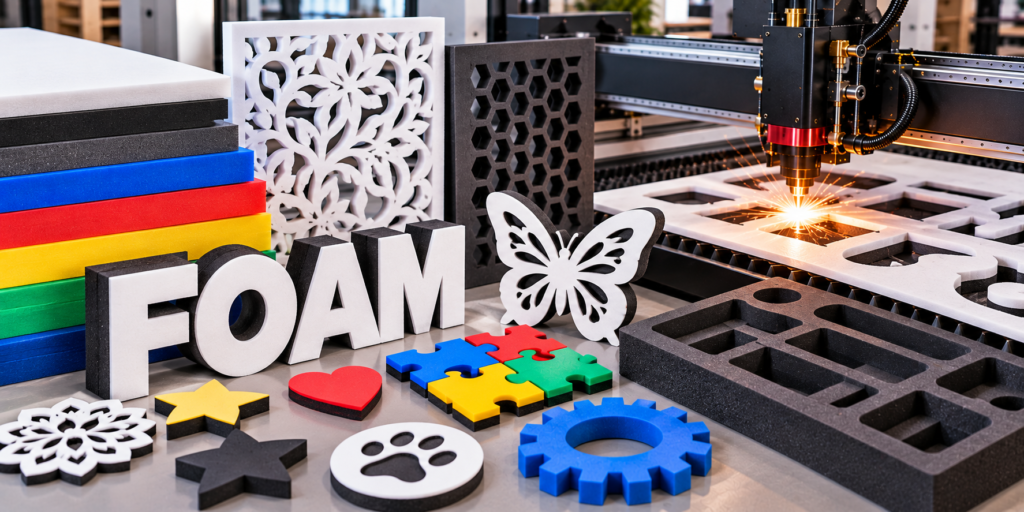
Foam is normally cut because something needs to fit, sit, separate or stay protected. That makes the relationship between the foam and the object just as important as the outside dimensions of the foam itself. At Laser Cutting Expert, we laser cut foam for protective packaging, presentation cases, tool storage, prototypes, displays, craft work and product organisation. Production takes place in our London workshop with no minimum order. We can produce a single prototype insert or repeat batches for commercial use. Customers can provide known laser-compatible foam or ask us to help source suitable material, with same-day London service available for appropriate projects.
CALL OR EMAIL US FOR PRICES
“Order any time of the day or night and receive your order on the same day in London. You are welcome to visit our laser cutting shop for an instant laser cutting service. On-site collection or free delivery can be arranged. Email us at laser@makergroup.uk for a quick quote or call us on 02036339857 for an instant price”.
Same Day Laser Cutting & Delivery
We can arrange a same day courier delivery with customer live tracking. Or customers can collect from our Laser Cutting Expert shop.
OPEN 24 HOUR
We are open 7 days a week, and you can order at any time. There is no last ordering time and no deadline. We also offer an overnight laser cutting service.

100% Satisfaction
High Quality Laser Cutting & 100% Customer Satisfaction Guarantee. Top-Rated Laser Cutting Company on Google.

Free File Check
We offer a free file check and proof before sending your artwork for laser cutting.
Start with What the Foam Needs to Do
Before choosing a foam, we look at its job. Packaging foam may need to absorb movement, while a presentation insert might primarily need to hold products neatly in position. Tool storage needs clear organisation, and a display component may be selected mainly for appearance. Custom laser cut foam should therefore be designed around density, thickness, compression and the dimensions of the item being held. Soft foam can deform around an object, whereas firmer material may provide more defined support. The exact foam chemistry also matters because not every foam is laser compatible. Material identification comes before production, particularly when customers supply specialist or unfamiliar foam themselves.
Foam Inserts Built Around the Product
Laser cut foam inserts can be designed around tools, instruments, samples, electronic products, promotional items and other objects that need a controlled position inside a box or case. The cavity should not simply copy the maximum outside dimensions of the product. Finger access, removal direction, compression and fragile features also need consideration. A tightly fitting recess may look neat but become frustrating if the object cannot be lifted out easily. Inserts can contain one large cavity or many individual positions. We can work from CAD drawings, accurate product measurements or suitable supplied information to develop the profiles needed for one-off cases and repeat packaging systems.
Protective Cases and Equipment Storage
Flight cases, equipment boxes and protective containers often use foam to stop contents moving during transport. We laser cut foam for suitable camera equipment, instruments, demonstration kits, electronics, measuring equipment, tools and product samples. The foam layout can separate individual items while making it immediately obvious when something is missing. Cable spaces, accessory compartments and finger pulls can also be incorporated. The case dimensions should be confirmed before the insert is manufactured because even a small difference in internal size can affect fit. Where equipment is particularly valuable or fragile, a prototype insert can be checked physically before a complete set of cases is produced.
Tool Control and Workshop Inserts
Organised tool storage becomes easier when every item has its own position. Custom laser cut foam can be used inside drawers, cabinets, cases and mobile toolboxes for spanners, sockets, measuring equipment, hand tools and specialist instruments. Cut-outs can follow the approximate shape of each tool, helping users return equipment to the correct location. Contrasting foam layers may also make an empty position easier to see. The insert design should leave sufficient foam between neighbouring cavities so the structure remains stable. For workshops with several identical tool sets, one approved layout can then be repeated across multiple drawers or cases without manually tracing and cutting every tool position.
EVA Foam for Product and Craft Applications
Laser cut EVA foam is requested for a wide range of products because EVA is available in different thicknesses, densities and colours. Suitable applications can include case inserts, craft shapes, costume components, model parts, pads, spacers and display pieces. However, the exact EVA formulation should still be confirmed because materials sold under similar names may contain different additives. Density influences both the way the foam feels and how well it holds fine detail. Thin EVA can suit decorative components, while thicker material may be used for cushioning or layered products. We assess the supplied specification and intended result before selecting appropriate production settings for the job.
Presentation Boxes and Branded Packaging
Packaging is not always about surviving heavy transport. For awards, gifts, jewellery, product samples and promotional products, the foam can also form part of the presentation. Laser cut foam inserts can position several components neatly inside a rigid box, case or presentation pack. Cavities may be arranged symmetrically or follow the shape of the product itself. Finger notches can make removal easier, while layered construction can provide additional depth. The foam colour can also be selected to complement the product or outer packaging. This works well for short-run presentation kits where conventional mass-production packaging would be unnecessary or where the product arrangement changes between different versions.
Layered Foam for Deeper Cavities
A single foam sheet does not always provide enough depth for the item being held. One solution is to build the insert from several layers. With custom laser cut foam, each layer can contain different geometry so the finished assembly supports the product at different depths. A lower layer might remain mostly solid while upper layers form the main cavity. This method can work for tools, electronics, presentation products and irregularly shaped objects. Alignment between layers should be planned so cavities remain correctly positioned after assembly. Layered construction also gives designers more control over support without requiring every feature to be cut through the complete thickness of a single foam block.
Electronics and Instrument Packaging
Electronic products often include several separate items: the main device, charger, cables, adapters, accessories and documentation. Laser cut foam inserts can organise these components into one case or package so they remain separated during storage and presentation. Instruments may need similar arrangements for probes, attachments or calibration accessories. Foam selection should reflect the sensitivity and weight of the equipment, while the product manufacturer should specify any requirements relating to static control or specialist protective materials. Ordinary foam should not automatically be assumed suitable for sensitive electronics. Where anti-static or conductive performance is required, the exact material specification must be confirmed before cutting and final packaging.
Foam for Product Samples and Sales Kits
Sales teams often carry several samples in one presentation case. Without an insert, components can move around and the case quickly becomes untidy. We laser cut foam to create organised sample layouts for manufacturers, sales representatives, exhibitions and product demonstrations. Cavities can hold material samples, small products, colour swatches, components or demonstration equipment. Labels or printed information can be positioned around the foam separately where required. The insert can also be designed so the most important product appears first when the case opens. Because there is no minimum order, businesses can develop one sales kit, test it with their team and then produce more once the layout is approved.
Foam Components for Models and Prototypes
Foam is useful during product development because it is lightweight and available in many forms. Designers can use custom laser cut foam for mock-ups, spacing pieces, prototype packaging, model components and test assemblies before deciding on a final manufacturing material. Foam pieces can help establish approximate size, position and interaction between components without the cost of machining a harder material at an early stage. Model makers may also use suitable foam for scenery, structures or dimensional pieces. The correct cutting method depends on the exact foam chemistry and thickness. Unknown foams should be identified before processing rather than tested simply because they appear visually similar to a compatible material.
Displays, Exhibitions and Visual Merchandising
Foam can provide lightweight shapes for temporary displays, exhibition builds and visual merchandising. Suitable material can be used for dimensional lettering, backing pieces, product supports, decorative shapes and prototype display components. Laser cut EVA foam may also work for certain coloured or layered display details where a flexible material is preferred. Large unsupported pieces can bend, so the design should account for how the foam will be mounted or supported. Display components may also be combined with acrylic, plywood, card or printed graphics. For short events, digital cutting makes it possible to create custom shapes without ordering dedicated cutting dies or large quantities of identical components.
Craft, Costume and Creative Foam Shapes
Makers and creative businesses use foam for masks, costume details, props, decorative shapes, flowers, lettering and model components. Laser cut EVA foam is particularly useful for suitable costume and craft applications because individual profiles can be produced from digital artwork and later assembled into larger forms. Repeated pieces can be cut consistently for armour-style costume elements, decorative panels or layered props. Heat forming, gluing and painting may follow after cutting depending on the project. Designers should remember that narrow foam details can stretch or tear during handling. The artwork therefore needs to balance visual complexity with enough material around delicate areas to keep the component practical.
Foam Pads, Spacers and Separators
Not every foam component is decorative. Simple pads, spacers, separators and cushioning pieces are used in packaging, product assembly and general manufacturing. We laser cut foam into circles, strips, rings, rectangles and custom profiles according to supplied dimensions. These parts may separate products inside a box, protect surfaces from contact or provide light cushioning between components. Where a foam piece performs a technical function, the customer should specify the required density, compression characteristics and environmental requirements. Cutting determines the profile but does not certify the foam for load-bearing, sealing, fire protection or other specialist performance. Those properties come from the selected material and finished-product design. Our related CNC Laser Cutting service can also be used where repeatable CAD-controlled production is required.
Measuring Products for Foam Cavities
Good laser cut foam inserts begin with reliable dimensions. For simple rectangular products, length, width and depth may be enough. Irregular objects often require more detailed measurements or CAD information. Finger access should be added intentionally rather than cutting the cavity so loosely that the product can simply be pulled out. Cables, handles, buttons and projecting parts may also need their own space. If several products share one case, enough foam should remain between cavities to keep the insert stable. Where dimensions are uncertain, a prototype can be manufactured first and physically checked before additional inserts are produced for the rest of the cases.
Material Identification and Foam Safety
“Foam” describes a structure rather than one chemical material. Different products may be made from EVA, polyethylene, polyurethane or other polymers, and additional adhesives, skins or coatings may be present. Some foams are suitable for laser processing while others can melt badly, ignite easily or release hazardous decomposition products. PVC and chlorine-containing foams must not be laser cut. For customer-supplied material, we therefore request the exact product specification or safety information where necessary. Custom laser cut foam should only proceed once the material is identified as compatible with the intended process. Unknown material is not accepted simply because another foam with a similar appearance was cut successfully.
Expert Technical Overview – Foam Laser Cutting
Successful foam cutting depends on chemistry, density, cell structure, thickness and heat response. When we laser cut foam, the objective is to produce the required profile without excessive melting or unwanted edge deformation. Laser cut EVA foam can behave differently depending on formulation and density, so sample testing may be useful. For laser cut foam inserts, cavity dimensions must also consider compression and how the object will be removed. Thick components may be better created as multiple aligned layers rather than one very deep cut. Unknown foams require identification first, and PVC or chlorine-containing materials are excluded from laser processing because of the hazardous gases they can release.
One Insert First, Then Repeat the Layout
Foam packaging is a good example of why prototyping matters. A CAD cavity can appear correct but still grip a product too tightly or leave more movement than expected. Producing one insert first allows the customer to test fit, finger access and overall presentation with the real product. Changes can then be made digitally before additional pieces are manufactured. Once approved, the same custom laser cut foam layout can support repeat batches for cases, sales kits or packaging. This is particularly useful when businesses introduce a new product because the packaging can develop alongside the product rather than requiring a large commitment before the final dimensions have been confirmed.
Same Day Foam Laser Cutting London
Replacement case inserts, exhibition displays and prototype packaging can sometimes be needed with very little notice. Our London workshop operates 24/7, including weekends and bank holidays, allowing suitable laser cut foam jobs to be considered for same-day production and local courier delivery. Urgent work still requires the material to be identified and confirmed as laser compatible. Customers can supply their own suitable foam or ask us to source material where possible. There is no minimum quantity, so an urgent project can consist of one insert or one prototype. Suitable completed orders can also be dispatched throughout the UK using next-day delivery options depending on production timing.
Foam Laser Cutting Near Me
Laser Cutting Expert provides foam cutting from our London workshop for customers throughout the UK. Designers, packaging companies, engineers, tool businesses, manufacturers, exhibition companies and private customers can send files digitally for assessment. Tell us the foam type, thickness, dimensions and quantity, together with information about the product or equipment the insert needs to hold. If you need custom laser cut foam but do not yet have production-ready artwork, design support is available. Suitable London projects can be produced with same-day courier delivery, while next-day UK delivery can be arranged for appropriate completed work. One-offs and repeat orders are both welcome.
FAQs About Foam Laser Cutting
1. What foam can you laser cut?
It depends on the foam chemistry and formulation. We need to identify the material before confirming that laser processing is suitable.
2. Can you make custom case inserts?
Yes. We produce laser cut foam inserts for equipment cases, toolboxes, presentation boxes, sample kits and suitable product packaging.
3. Can you laser cut EVA foam?
Yes, suitable laser cut EVA foam projects can include inserts, craft shapes, costume components, pads and display pieces, subject to the exact material specification.
4. Can I send you my own foam?
Yes, provided the foam can be positively identified and is suitable for laser processing. Technical or safety information may be required for unfamiliar materials.
5. Can you make layered foam inserts?
Yes. Multiple cut layers can be aligned and assembled to create deeper cavities or different support levels within an insert.
6. Can you design an insert around my product?
Yes. We can work from suitable CAD information, accurate measurements or other usable product dimensions to prepare a custom cavity layout.
7. Do you have a minimum order?
No. You can order one prototype insert, a small set of components or repeat batches of custom laser cut foam products.