
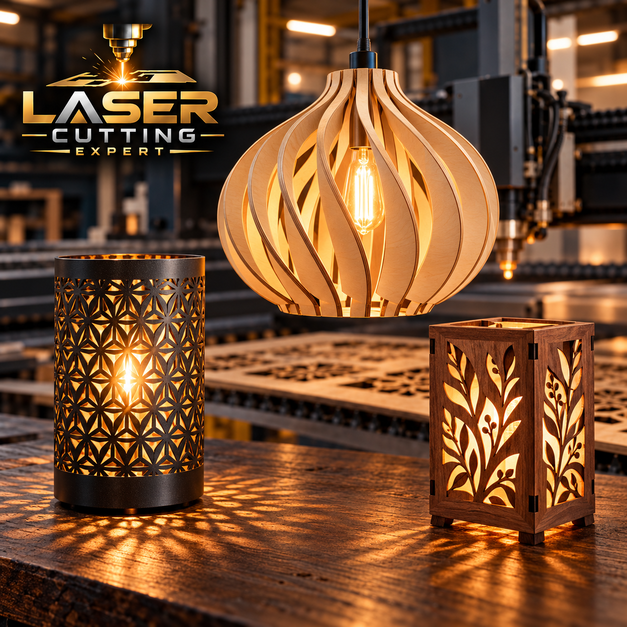
A lampshade changes twice: once when you look at it during the day, and again when the light is switched on. The pattern, openings and material suddenly create shadows, highlights and areas of contrast that are not obvious from a flat CAD drawing. At Laser Cutting Expert, we manufacture custom lighting components and laser cut lampshade parts from our London workshop for lighting designers, interior studios, architects, makers and individual customers. We can produce prototypes, replacement panels, flat-pack shade components and short production runs from suitable laser-compatible materials. Customers can provide finished cutting files or ask us to help prepare an idea for manufacture. There is no minimum cutting quantity.
CALL OR EMAIL US FOR PRICES
“Order any time of the day or night and receive your order on the same day in London. You are welcome to visit our laser cutting shop for an instant laser cutting service. On-site collection or free delivery can be arranged. Email us at laser@makergroup.uk for a quick quote or call us on 02036339857 for an instant price”.
Same Day Laser Cutting & Delivery
We can arrange a same day courier delivery with customer live tracking. Or customers can collect from our Laser Cutting Expert shop.
OPEN 24 HOUR
We are open 7 days a week, and you can order at any time. There is no last ordering time and no deadline. We also offer an overnight laser cutting service.

100% Satisfaction
High Quality Laser Cutting & 100% Customer Satisfaction Guarantee. Top-Rated Laser Cutting Company on Google.

Free File Check
We offer a free file check and proof before sending your artwork for laser cutting.
Designing with Light Rather Than Just Material
A decorative pattern that looks attractive on a computer screen may behave very differently around a light source. Large openings allow stronger points of light through, while smaller repeated openings can create softer patterns and more detailed shadows. The distance between the light source, shade and nearby wall also changes the effect. For this reason, lighting components are best developed as physical objects rather than treated only as decorative sheet cutting. We can produce one prototype first, allowing the designer to evaluate light distribution, shadow pattern, rigidity and assembly before approving the remaining components. This is particularly useful for new products and bespoke interior installations.
Laser Cut Lampshade Design
A laser cut lampshade can use geometric patterns, botanical artwork, abstract forms, lettering or completely bespoke designs. The pattern should leave enough connected material for the shade to remain stable once assembled. Narrow bridges can become weak, particularly on larger panels, while extremely dense patterns may restrict the intended light effect. The overall shade geometry also matters. Cylindrical, polygonal, layered and panel-built shades all require different construction methods. We can cut individual faces, interlocking components or suitable flexible pattern sections according to the customer’s design. Where multiple pieces form one shade, locating tabs or assembly references can be incorporated into the cutting files.
Lampshades for London Interior Projects
Lighting often becomes a focal point in restaurants, hotels, retail spaces, offices and residential interiors. London interior designers may need one oversized shade for a reception area, a small group of matching pieces for a restaurant or custom components for an installation that cannot be bought off the shelf. Our no-minimum approach suits this type of project because production can follow the actual interior requirement rather than a standard manufacturing quantity. Designers working around areas such as Clerkenwell, Shoreditch, Chelsea, Mayfair and the City can also use our London production for suitable urgent prototypes and replacement components when project deadlines are close.
Pendant Light Shade Components
Pendant shades need to be considered from every viewing angle because the underside and internal construction can remain visible. Laser-cut panels can form the outer body, while additional rings or structural components may help maintain the intended shape. The position of the lamp holder and light source should be established before the shade dimensions are finalised. Designers should also consider how the shade will be assembled and accessed when a lamp needs replacing. We manufacture suitable non-electrical components from approved drawings, but the complete lighting product, suspension system and electrical arrangement should be specified and validated by the responsible lighting designer or manufacturer.
Table and Floor Lamp Shade Panels
Table and floor lamps place the shade closer to eye level, making edge detail and material finish particularly noticeable. A repeating cut pattern can provide visual interest even when the lamp is switched off, while layered panels can hide or reveal different areas once illuminated. The shade should remain proportionate to its base and stable within the intended supporting structure. We can manufacture matching panels, rings and suitable decorative components for new designs or replacement projects. If an existing shade is being reproduced, accurate dimensions should be taken from the frame or supporting structure rather than relying only on a damaged or distorted old panel.
Layered Lighting and Diffuser Designs
A cut outer layer can be combined with a separate diffuser to change how light appears through the openings. Without diffusion, individual bright points from a light source may remain visible. With suitable spacing and diffuser material, the same pattern can appear softer and more even. Layering can also introduce colour or create a second pattern behind the first. The distance between layers needs to remain consistent if the designer wants a uniform effect around the shade. We can manufacture suitable laser-cut structural and decorative components, while diffuser materials must be checked for compatibility with the intended light source, operating temperature and overall lighting product design.
Shadow-Casting Lampshades
Some shades are deliberately designed around the shadow rather than the shade itself. Cut-outs can project patterns onto nearby walls and ceilings when the light source is positioned correctly. The final result depends on the size of the openings, shape geometry, lamp position and distance to the surrounding surface. Small changes in these relationships can produce noticeably different shadows. A prototype is therefore especially valuable for this type of product. We can cut several pattern variations so a designer can compare them under the actual intended light source. Once the preferred version has been selected, the approved geometry can be used for additional matching shades.
Lighting Components for Hospitality and Retail
Restaurants, bars, hotels and retail spaces often require several lighting pieces that share the same design language but differ in size. A large feature shade may sit above a reception desk while smaller versions repeat the pattern elsewhere in the room. Laser cutting allows the same artwork to be adapted across suitable component sizes without forcing every fixture to be identical. Branding can also be incorporated subtly through a pattern or logo where appropriate. For multi-site projects, approved files can be retained for later repeat production. This helps businesses replace individual components or add another matching location without developing the decorative geometry again from the beginning.
Flat-Pack Lampshade Components
Some lampshades can be designed as flat pieces that interlock or assemble around a central structure. This can simplify storage and transport, particularly for product designers selling shades online or moving installations between events. Slot dimensions should be based on actual material thickness rather than nominal sheet specifications. A joint that is too loose can make the finished shade unstable, while one that is too tight may damage the component during assembly. We can cut small test joints before producing the complete shade. Assembly numbers or discreet reference marks can also be added using our related page Laser Cut Maps, Art & Decorations where the chosen material and design are suitable.
Materials for Laser Cut Lighting
Suitable plywood, wood-based sheet, acrylic, metal and other compatible materials can be considered depending on the lighting design. Material choice affects weight, rigidity, appearance and how much light passes through the pattern. It also affects heat behaviour, which is particularly important around lighting products. A material that is suitable for decorative laser cutting is not automatically suitable for placement close to a heat-producing lamp. Designers should specify the intended light source and required clearances when developing the complete fixture. We manufacture the cut components, while the finished product’s electrical, thermal, fire and installation requirements remain the responsibility of the appropriate product designer or manufacturer.
Pattern Density and Structural Strength
Removing more material does not automatically produce a better lighting effect. A very open pattern may create strong shadows but leave the panel weak. A dense pattern can retain more apparent surface area but may introduce hundreds of narrow bridges that are individually fragile. Pattern direction also influences the way forces travel through the component. Around fixing points, slots and structural edges, additional material may need to remain intact. We review suitable cutting geometry for manufacturability, but load-bearing and product-safety requirements should be established by the designer. For large shades, supporting frames or rings may be required rather than expecting a decorative patterned sheet to support itself.
Expert Technical Overview – Laser Cut Lighting & Lampshades
A laser cut lampshade should be developed around light behaviour, material strength and safe clearance rather than pattern alone. Minimum bridge width affects whether detailed cut-outs remain connected, while open-area percentage influences rigidity and light transmission. The position of the light source changes shadow size and intensity. Layered designs also need consistent spacing between the decorative surface and diffuser. Material heat resistance must be appropriate for the intended fixture. LED systems can reduce heat compared with some traditional lamps, but the complete lighting product still requires proper thermal and electrical assessment. Final safety, wiring and certification remain the responsibility of the lighting manufacturer or qualified professional.
LED Lighting and Heat Considerations
LED lighting is commonly used in decorative fixtures because it can provide compact illumination with lower heat output than many traditional sources, but “LED” does not mean that temperature can be ignored. Drivers, high-output modules and enclosed fixtures can still generate heat. Air movement and ventilation may need to be built into the product. Laser-cut openings can contribute to airflow, but they should not be treated as a substitute for proper thermal design. We recommend that customers establish the light source and electrical arrangement before finalising the shade geometry. This allows decorative cutting, internal clearances and structural components to be developed around the real fixture rather than an assumed one.
From Prototype to Lighting Collection
A new lighting product rarely needs to begin with a large production batch. One laser cut lampshade can be assembled, photographed and tested in the intended room before another is produced. The designer can then change the diameter, pattern scale, panel connections or diffuser spacing based on what happens physically. Once the construction is working properly, related sizes can be developed from the approved design. This approach suits independent lighting designers and interior brands building small collections. There is no minimum cutting quantity, so production can remain at prototype or short-run level until demand justifies larger repeat batches.
Same Day Laser Cut Lampshades London
When a lighting prototype is needed for a client presentation or an interior installation has a tight deadline, suitable cut-ready components may qualify for same-day production at our London workshop. Customers can send CAD or vector files remotely along with the required material, thickness and dimensions. We operate 24/7, including weekends and bank holidays. Same-day London courier delivery can be arranged for qualifying completed work. For customers outside London, next-day UK delivery is available for many suitable orders. Complex assemblies, specialist materials and projects requiring design development may take longer, so turnaround is confirmed according to the actual project rather than applying one deadline to every shade.
Laser Cut Lighting & Lampshades Near Me
Our London workshop supports lighting designers, architects, furniture makers, interior studios, hospitality businesses and individual customers across the UK. You can order a single prototype, replacement panel or repeat set without a minimum quantity. We can work from production-ready files or assist with preparing suitable cutting geometry from a developed concept. Customers may also provide their own identified laser-compatible materials, subject to approval. Suitable urgent work can be produced and delivered within London on the same day, while fast delivery is available throughout the UK. All manufacturing is handled with the final component dimensions and assembly requirements in mind.
FAQs About Laser Cut Lighting & Lampshades
1. Can you make just one custom lampshade prototype?
Yes. There is no minimum order, so we can manufacture a single set of suitable components for testing before further production.
2. Can you cut a custom pattern into a lampshade?
Yes. Geometric, botanical, abstract and other suitable vector patterns can be cut according to the material and structural requirements.
3. Can you make flat-pack lampshade parts?
Yes. Suitable designs can use interlocking or slot-together components. Joint dimensions should be tested against the actual material thickness.
4. Can you reproduce a damaged lampshade panel?
Potentially, yes. Accurate dimensions from the original supporting structure are preferable to measurements taken only from a damaged panel.
5. Which materials can be used for lighting components?
Suitable plywood, acrylic, metal and other laser-compatible materials may be considered. Material choice must also be appropriate for the intended lighting environment and temperature.
6. Can you manufacture lampshade components on the same day?
Yes, suitable cut-ready London projects may qualify for same-day production depending on material availability, complexity and workshop capacity.
7. Do you manufacture the electrical parts of the light?
Our focus is the laser-cut components. Electrical design, wiring, thermal assessment, certification and final product safety should be handled by the responsible lighting manufacturer or qualified professional.