
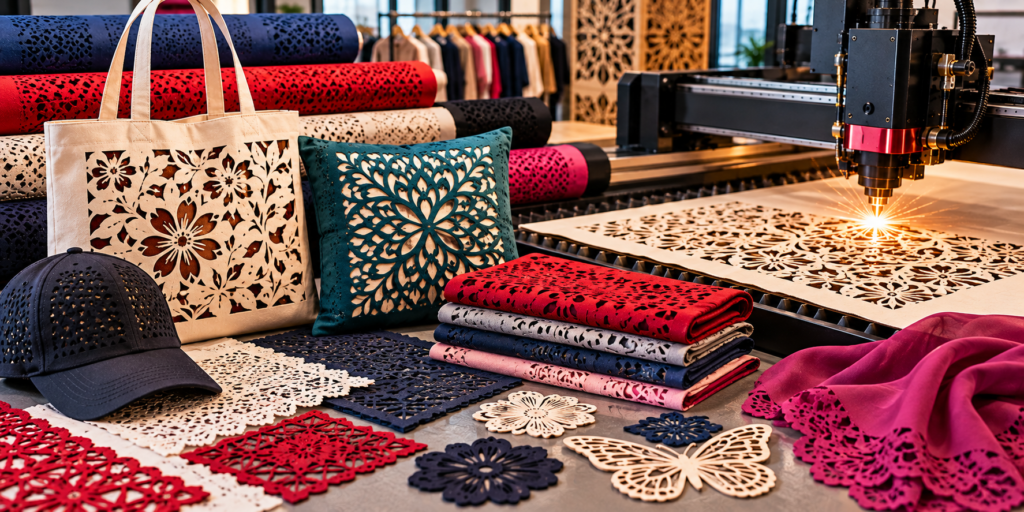
Fabric changes shape, stretches, frays and moves in ways that rigid sheet materials do not, so cutting it properly starts with understanding the textile construction. At Laser Cutting Expert, we laser cut fabric for fashion, upholstery, interiors, crafts, product development, technical applications and prototype work from our London production workshop. Our fabric laser cutting service handles suitable woven, non-woven and synthetic textiles where the fibre composition is known and compatible with laser processing. Products can include garment panels, appliqué, patches, bags, decorative textile pieces, felt shapes, upholstery components and templates. We accept one-offs and production quantities, with no minimum order requirement.
CALL OR EMAIL US FOR PRICES
“Order any time of the day or night and receive your order on the same day in London. You are welcome to visit our laser cutting shop for an instant laser cutting service. On-site collection or free delivery can be arranged. Email us at laser@makergroup.uk for a quick quote or call us on 02036339857 for an instant price”.
Same Day Laser Cutting & Delivery
We can arrange a same day courier delivery with customer live tracking. Or customers can collect from our Laser Cutting Expert shop.
OPEN 24 HOUR
We are open 7 days a week, and you can order at any time. There is no last ordering time and no deadline. We also offer an overnight laser cutting service.
100% Satisfaction
High Quality Laser Cutting & 100% Customer Satisfaction Guarantee. Top-Rated Laser Cutting Company on Google.

Free File Check
We offer a free file check and proof before sending your artwork for laser cutting.
Fibre Composition Changes the Cut Edge
The result from laser cutting textiles depends heavily on what the fibres are made from. Some synthetic fabrics can produce a lightly sealed edge because heat melts the fibres along the cut line, while natural materials such as cotton behave differently and may retain an edge that can fray. Blended textiles introduce another variable because each fibre may react differently. Coatings, backing materials, adhesives and treatments also need to be identified. We therefore ask customers for the fabric specification wherever possible. Unknown coated textiles are not automatically accepted because the visible face does not tell us what chemicals or additional layers may be present inside the material.
Fashion, Garments and Clothing Components
Custom laser cut fabric is useful where garment designers need repeatable shapes, decorative openings or individual components cut directly from digital patterns. Suitable projects can include dress panels, skirts, shirt details, leggings, underwear components, appliqué, embroidery backing pieces, bags and fashion accessories. Laser cutting can also create decorative perforations and repeated motifs that would take considerably longer to reproduce manually. Stretch direction, fabric movement and edge behaviour need to be considered when preparing the pattern. For clothing that will later be stitched, bonded or assembled, seam allowances and joining areas should remain part of the production file rather than being added after the components have already been cut.
Felt Laser Cutting for Shapes and Products
Felt laser cutting is useful for craft products, decorative shapes, pads, inserts, organisers, educational pieces and selected industrial applications. Felt is available in different fibre compositions, densities and thicknesses, so two sheets that look similar may respond differently during processing. Synthetic felt may react differently at the edge from wool or blended felt, making material identification important before production. Products can include coasters, ornaments, flowers, letters, bag components, protective pads, dividers and display pieces. We can also produce repeated felt profiles for businesses that need consistent dimensions. Our related High Volume & Contract Laser Cutting service is suitable for designs containing more intricate cut patterns.
Upholstery Fabric Cutting
Laser cutting for upholstery fabric can help furniture makers, interior designers, upholsterers and prototype workshops prepare repeatable textile components from digital patterns. Applications can include seat panels, decorative overlays, furniture textile components, templates and prototype pieces for chairs, sofas, headboards or interior products. Upholstery materials vary significantly and may contain backing layers, coatings, adhesives, foam laminations or fire-retardant treatments. These must be identified before laser processing is considered. We can work from CAD patterns or help prepare digital profiles, but the material itself must be confirmed as suitable. Final upholstery construction, durability and regulatory requirements remain the responsibility of the product manufacturer or upholsterer.
Carpet Fabric and Floor Textile Components
Laser cutting for carpet fabric can be useful for samples, decorative inserts, display pieces, templates and selected custom floor-textile components where the material composition is compatible with laser processing. Carpet construction can involve surface fibres, woven or tufted structures, backing materials, adhesives and additional coatings, so the complete product must be considered rather than only the visible pile. Some carpet materials are unsuitable for laser cutting because of their backing or chemical composition. For suitable materials, digital cutting can help reproduce curved profiles, logos or repeatable shapes. Large pieces also require careful handling because heavy or flexible textile material can move or distort during positioning and production.
Fabric for Bags, Patches and Accessories
Many smaller textile products begin as flat profiles before sewing or assembly. Our fabric laser cutting service can prepare suitable components for tote bags, fashion bags, patches, labels, appliqué, straps, decorative inserts and other accessories. Laser cutting is particularly useful where the same profile needs to be repeated or where the design contains detailed curves that are difficult to reproduce consistently by hand. Synthetic materials may produce a more sealed edge, while natural fabrics may still require normal textile finishing. Hole positions, stitch lines and seam allowances can also be incorporated into the digital pattern where appropriate. Customers can send finished CAD files or provide dimensions for design preparation.
Composite Fabric Requires Material Confirmation
Requests for laser cutting for composite materials fabric require careful technical review because the term composite can describe many completely different constructions. A fabric may contain glass fibres, carbon reinforcement, resin, adhesive, film, foam or several bonded layers. Each component affects whether laser processing is safe and whether it will produce a useful cut. We therefore need the exact material specification and preferably technical or safety information before accepting composite textile work. Suitable manufacturing methods are chosen from the actual construction rather than the general description “composite fabric”. This avoids damaging material, producing unacceptable edges or processing substances that should not be exposed to laser heat.
Carbon Fibre Fabric Cutting
Laser cutting for carbon fibre fabric needs to be distinguished from cutting cured carbon-fibre composite sheet. Dry woven carbon fibre, pre-impregnated material and fully cured composite are different materials and should not be treated as interchangeable. Resin systems, backing films and other additives can change the processing requirements considerably. Customers should therefore provide the exact product specification before work is assessed. Potential applications may include prototype reinforcement shapes, development samples and preform profiles for composite manufacturing. Where laser processing is not appropriate for the supplied carbon-fibre material, another cutting method should be selected. Finished structural composite components must also be validated by the responsible engineer or manufacturer.
Acoustic and Soundproofing Fabric
Laser cutting for soundproofing fabric can support acoustic panel manufacturers, interior designers, exhibition builders and product developers where suitable textile materials need custom profiles. Acoustic systems may use decorative face fabrics, absorptive layers, felt, foam or composite constructions, and these materials should not automatically be processed together. A laser-compatible face textile may require one method while the internal acoustic layer needs another. Suitable products can include decorative acoustic panel coverings, shaped felt components, wall features, ceiling elements and prototype sound-control products. Fire performance and acoustic performance of the finished installation should be verified by the responsible manufacturer or project professional rather than assumed from the cutting process alone.
Healthcare Textile Components
Requests involving laser cutting for healthcare sector fabric require more than accurate cutting because the intended application can carry hygiene, material-performance and regulatory requirements. Suitable laser-compatible textiles may be used for development samples, covers, non-clinical accessories, organisational products, prototype components or manufacturing trials. However, cutting a textile does not certify the finished product for medical or healthcare use. Fibre composition, coatings, cleanliness requirements and intended contact with people must be considered by the responsible manufacturer. Where a material is supplied for cutting, we need clear identification before production. Products intended as medical devices, protective equipment or safety-critical healthcare items require appropriate validation and compliance beyond our cutting operation.
Roof Fabric and Architectural Membranes
Laser cutting for roof fabric can involve coated textiles and architectural membranes used for canopies, temporary structures, tensile installations or specialist coverings. These materials vary greatly in composition and may include polymer coatings, reinforcement layers and chemical treatments. Some membrane materials, particularly those containing PVC or chlorine, must not be laser cut because hazardous and corrosive gases can be released. We therefore require the exact material specification before considering any roof textile. Where a suitable laser-compatible material is confirmed, CAD profiles can be assessed for prototype pieces or appropriate components. Structural performance, joining methods, weather resistance and installation remain matters for the responsible membrane manufacturer or engineer.
Air Dome Fabric and Large Technical Textiles
Laser cutting for air dome fabric requires similar material checks because air-supported structures use specialist membranes designed around strength, air retention, weather exposure and fire performance. These are not ordinary fabrics. Coatings and reinforcement systems must be positively identified before any laser process is considered. PVC or chlorine-containing membrane must not be laser cut. For confirmed compatible materials, digital cutting may be considered for appropriate development pieces, samples or components, but the structural integrity of an air dome depends on far more than profile accuracy. Seams, joining systems, reinforcement and engineering calculations must be specified and validated by the responsible manufacturer or structural specialist responsible for the finished installation.
Fabric Shapes for Interiors and Decorative Work
Textile cutting is also useful where the fabric itself becomes a visible design feature. Custom laser cut fabric can be shaped into decorative panels, flowers, geometric overlays, wall pieces, event decorations, lampshade textiles, exhibition details and layered artwork. Repeating the same pattern digitally helps maintain consistency when a project contains dozens or hundreds of individual elements. Material movement still needs to be considered because flexible fabric does not remain perfectly rigid like acrylic or plywood. The design should also leave enough material around narrow connections so delicate sections do not stretch or tear during handling. Layered pieces can combine different textures and colours to create more dimensional textile products.
Roll Material, Pattern Layout and Fabric Use
Efficient laser cutting textiles involves more than placing shapes randomly across a piece of material. Fabric width, pattern direction, grain, stretch and visible print orientation can determine how components should be arranged. Garment pieces may need to follow a consistent direction, while printed textiles may require alignment with a particular graphic. Good layout can reduce waste while keeping components correctly orientated. For repeated production, approved digital patterns can be retained and arranged again when more pieces are required. This approach works well for garment panels, bag parts, appliqué, upholstery pieces, felt shapes and decorative components where consistent geometry is needed across several individual textile pieces.
Expert Technical Overview – Fabric Laser Cutting
Reliable laser cut fabric production starts with fibre identification, thickness, weave, coatings and heat response. Synthetic textiles may melt and lightly seal at the edge, while natural fibres can char or continue to fray. Felt laser cutting also varies according to whether the felt is wool, synthetic or blended. For laser cutting for upholstery fabric, backing layers and treatments must be checked before processing. Composite and technical textiles require full material specifications because hidden resin, film or coatings may change suitability completely. PVC and chlorine-containing materials must not be laser cut. Testing a sample is useful when edge appearance, dimensional stability or heat response is uncertain.
Samples Before Full Textile Production
A small cutting test can answer questions that a material description cannot. Before a large order, we can assess how a confirmed compatible fabric responds around corners, small holes, detailed patterns and long straight edges. This is particularly useful for new fashion textiles, felt, upholstery fabrics and specialist technical materials. A sample also allows the customer to inspect edge appearance and determine whether the result works with later sewing, bonding or assembly. Once the material and pattern are approved, the same digital geometry can be used for further quantities. This reduces the risk of committing an entire roll or expensive specialist textile before its cutting behaviour has been properly checked.
Same Day Fabric Laser Cutting London
Fashion samples, exhibition components, event textiles and product prototypes often work to short deadlines. Our London production workshop operates 24/7, including weekends and bank holidays, allowing suitable urgent textile projects to be considered for same-day cutting and London delivery. Material must be identified and confirmed as laser compatible before urgent production begins. Customers can supply their own suitable fabric or ask us to help source material for the project. We have no minimum cutting quantity, so one prototype garment panel, patch or upholstery template can be produced without ordering a full production run. Suitable completed jobs can also be dispatched for next-day delivery across the UK.
Laser Cutting Fabric Near Me
If you are searching for laser cutting fabric near me, our London workshop works with designers, fashion businesses, upholsterers, makers, artists, students, manufacturers and product developers across the UK. Files can be sent digitally along with the fabric specification, thickness, dimensions and required quantity. Customers can also provide their own suitable textile once its composition has been confirmed. Our fabric laser cutting service covers prototypes, one-offs, small batches and repeat production. Same-day London Service and courier delivery are available for suitable urgent work, while next-day UK delivery can be arranged for appropriate completed orders. Design support is available where a cutting-ready pattern still needs preparation.
FAQs About Fabric Laser Cutting
1. What fabrics can you laser cut?
Suitability depends on fibre composition, coatings, backing and thickness. We assess the actual textile before production rather than assuming all fabrics are laser compatible.
2. Can you laser cut felt?
Yes, suitable felt laser cutting projects can include craft shapes, pads, decorations, organisers and other components. The type of felt should be identified first.
3. Can you cut upholstery fabric?
We can assess laser cutting for upholstery fabric when the textile composition, backing and coatings are known and suitable for laser processing.
4. Does laser cutting stop fabric from fraying?
Some synthetic fabrics can develop a heat-sealed edge, but natural fibres and some blends may still fray. The result depends on the material.
5. Can you cut carbon fibre fabric?
Laser cutting for carbon fibre fabric requires technical assessment. Dry fabric, prepreg and cured composite are different materials, so the exact specification must be supplied.
6. Can you cut PVC-coated fabric?
No. PVC and other chlorine-containing materials must not be laser cut because heating them can produce hazardous and corrosive gases.
7. Do you accept one-off fabric projects?
Yes. There is no minimum order. We can handle a single sample or prototype as well as short batches and repeat textile production.