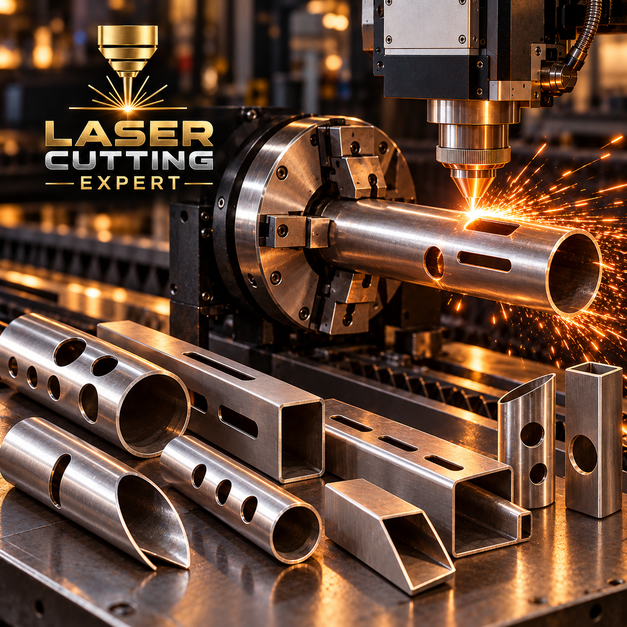
Cutting tube is different from cutting a flat sheet. The machine has to control the workpiece around its circumference while placing holes, slots, mitres, notches and end profiles exactly where the fabrication needs them. Laser Cutting Expert provides tube laser cutting and pipe laser cutting from our London production workshop for one-off components, prototypes, fabrication kits and repeat production. Our service is available to engineering companies, fabricators, furniture makers, sign companies, construction businesses, designers and individual customers across the UK. We work with suitable round, square, rectangular and specialist profiles, with no minimum cutting quantity and same-day London service available for suitable urgent jobs.
CALL OR EMAIL US FOR PRICES
“Order any time of the day or night and receive your order on the same day in London. You are welcome to visit our laser cutting shop for an instant laser cutting service. On-site collection or free delivery can be arranged. Email us at laser@makergroup.uk for a quick quote or call us on 02036339857 for an instant price”.
Same Day Laser Cutting & Delivery
We can arrange a same day courier delivery with customer live tracking. Or customers can collect from our Laser Cutting Expert shop.

OPEN 24 HOUR
We are open 7 days a week, and you can order at any time. There is no last ordering time and no deadline. We also offer an overnight laser cutting service.

100% Satisfaction
High Quality Laser Cutting & 100% Customer Satisfaction Guarantee. Top-Rated Laser Cutting Company on Google.

Free File Check
We offer a free file check and proof before sending your artwork for laser cutting.
Tube Laser Cutting Services
Our tube laser cutting services are designed around the component that needs to be fabricated afterwards, not simply around making a cut through metal. We can produce suitable end cuts, holes, slots, notches, mitres, tabs and connection features directly from CAD. This can reduce manual marking, drilling and sawing when several operations would otherwise be required. Typical work includes frames, furniture structures, machine components, display systems, rails, brackets, supports and fabricated assemblies. Customers can order one development component or repeat quantities. If you already have production drawings, send them with the tube dimensions, wall thickness, material and quantity so we can assess the complete job.
Pipe Laser Cutting
Our pipe laser cutting service can be used for suitable round tubular components where accurate openings, end profiles or connection features are needed. Instead of manually drilling holes around a curved surface, the cutting path can follow the pipe geometry according to the digital model. Applications can include frames, equipment structures, handrail components, furniture, display systems, machinery and custom fabrication. Outside diameter, wall thickness, material grade and tube length all need to be known before production. Pipe terminology can also vary between industries, so actual dimensions are more useful than a general description. Pressure-containing pipework requires separate engineering, fabrication, welding, inspection and certification beyond profile cutting.
Round Tube Components
Round tube appears in furniture, frames, handrails, equipment, stands and fabricated structures. With tube laser cutting, holes can be positioned around the circumference and ends can be profiled for suitable connections. Fish-mouth or saddle-style profiles can also help one tube locate against another before welding, depending on the design. This can be useful for frame construction where repeatable positioning matters. We can work from suitable CAD information and produce development pieces before a complete batch. The finished strength of a tubular assembly still depends on material grade, wall thickness, joint design and welding quality. Structural connections should therefore follow drawings approved by the responsible engineer or fabricator.
Square Tube Laser Cutting
Frames, furniture and equipment structures often use square hollow section because its flat faces make mounting and assembly straightforward. Square tube laser cutting allows suitable holes, slots, end profiles and locating features to be placed on different faces without manually repositioning the part for every operation. Products can include table frames, display stands, shelving structures, machine frames, sign supports, garden structures, gates and furniture components. Corner radius, actual section size and wall thickness should be considered when features approach an edge. If the tube will carry structural loads, the responsible engineer must determine section size and connection design rather than selecting the tube solely according to appearance.
Rectangular Tube and Box Section
Rectangular hollow section is useful where a frame needs different dimensions in its vertical and horizontal directions. Our tube laser cutting services can produce suitable RHS components for equipment frames, furniture, retail displays, workstations, partitions, support structures and architectural fabrication. Holes can be placed on individual faces while ends can be mitred or shaped according to the assembly. Slots and tabs may also help components locate during fabrication. Actual section dimensions, wall thickness and corner radius should be included in the CAD model. Parts intended for structural use need appropriate engineering calculations, particularly where large openings remove material from highly loaded areas of the tube.
3D Tube Laser Cutting
Some tube components need more than a straight perpendicular cut. 3d tube laser cutting can be relevant where the cutting path must follow complex geometry around a three-dimensional tubular profile. This may include angled end preparations, intersecting tube joints, shaped openings and features positioned across different faces or around curved surfaces. Such capability can support fabricated frames, machinery, architectural structures and specialist assemblies. A proper 3D model is particularly useful because it shows how the tube features relate to each other spatially. The feasibility of a particular component depends on profile shape, dimensions, wall thickness, access and machine capability, so complex projects should be reviewed before production.
CNC Laser Tube Cutting
Repeatable fabrication begins with controlled digital geometry. Cnc laser tube cutting uses programmed component information to position cutting features consistently along and around the tube. This is useful for batches containing repeated holes, slots, notches and end profiles. It can reduce the variation associated with manually marking each tube before drilling or sawing. Suitable applications include furniture frames, display structures, equipment supports, architectural components, workshop systems and manufacturing assemblies. CNC control does not remove the need for accurate drawings. Incorrect dimensions in the model will simply be repeated consistently, so prototypes are sensible when a new component needs to fit existing equipment or connect with several other fabricated parts.
Fiber Laser Tube Cutting
For suitable metal tube applications, fiber laser tube cutting provides a productive way to create profiles directly from digital files. The appropriate process depends on material, wall thickness, tube dimensions and required feature quality. Applications can include stainless steel, mild steel and suitable aluminium tubular components, along with other compatible metals after assessment. Different materials respond differently to laser energy, so machine settings and assist-gas requirements should not be treated as universal. Reflective metals require particularly appropriate equipment and process control. Customers should provide the actual material grade whenever it affects performance. We can then assess whether the tube and requested geometry are suitable for the intended cutting method.
Mild Steel Tube Cutting
Mild steel tube is common in general fabrication because it can be used for frames, furniture, machinery, gates, stands and structural assemblies. Our tube laser cutting service can produce suitable mitres, slots, holes, notches and connection profiles before components move into welding or bending. Products can include table bases, shelving frames, equipment stands, machine guards, garden frames, sign structures and workshop furniture. Bare mild steel generally requires suitable finishing where corrosion is a concern. If components will be powder coated, painted or galvanised after fabrication, the manufacturing sequence should be considered from the beginning. Structural assemblies must use the steel section specified by the responsible engineer.
Stainless Steel Tube Cutting
Stainless tube can be used where corrosion resistance, hygiene or visible appearance is important. Suitable tube laser cutting services can support furniture, architectural details, rails, equipment frames, kitchen components, retail displays and specialist machinery. Stainless grade should be selected according to the actual environment rather than appearance alone. Brushed or polished tubes also need careful handling because the visible face may be part of the finished product. If cutting is followed by welding, the fabricator should use procedures appropriate to the specified stainless grade. Food, medical and hygienic equipment requires product-level design and validation; laser cutting stainless tube alone does not make the completed assembly compliant with those requirements.
Aluminium Tube Cutting
Aluminium tube is useful where reducing weight is important. Frames, exhibition structures, furniture, equipment supports, display systems and prototype assemblies can all use suitable aluminium profiles. Through tube laser cutting, holes, slots and end shapes can be incorporated before assembly. Alloy and temper should be known because aluminium products are not all mechanically identical. Reflectivity and thermal conductivity also influence the cutting process. Thin-wall tube can be sensitive to handling and heat, so geometry needs to remain practical. Load-bearing aluminium frames require engineering around section dimensions, joint design and alloy. We manufacture the profiles according to approved information rather than determining the safe working capacity of the finished structure.
Galvanised Tube and Coated Sections
Galvanised tube can be useful for frames and structures intended for damp or outdoor environments. Our pipe laser cutting and tubular profiling service can be considered for suitable zinc-coated sections, but the coating needs additional attention. Cutting exposes the underlying steel locally and heating zinc can create hazardous fumes, particularly during subsequent welding. Fabricators need appropriate extraction, preparation and corrosion-repair procedures. Products might include outdoor frames, equipment supports, garden structures, sign frames and utility components. Where long service life outdoors is important, designers should decide whether pre-galvanised tube or fabrication followed by galvanising provides the more appropriate coating system for the completed assembly.
Tube Frames for Furniture
Tubular metal works particularly well for tables, chairs, benches, shelving and other furniture because relatively lightweight sections can form rigid frames. Our tube laser cutting services can prepare rails, legs, cross-members and connection pieces with suitable locating features already incorporated. Square tube laser cutting is particularly useful for table frames, shelving and modern furniture structures where flat faces simplify joining. Slots and tabs can help components locate before welding, while mitred ends can reduce manual preparation. Decorative metal panels, laser-cut furniture inserts and other flat components can then be combined with the tube frame to create a complete product. Final furniture stability remains the manufacturer’s responsibility.
Retail Display and Exhibition Frames
Retail and exhibition structures often need to be assembled quickly while maintaining accurate alignment. Tube laser cutting can create frame components for product stands, exhibition displays, counters, sign structures and temporary installations. Holes for shelves, graphics, panels or fixings can be included directly within the tube. Components can also be numbered or organised as fabrication kits where appropriate. Aluminium may be selected for lighter portable displays, while steel can suit more permanent structures. If the same display is needed for several locations, digital production files make repeat manufacturing easier. Large public-facing installations should still be checked for stability, loading and safe assembly by the organisation responsible for the finished display.
Sign Frames and Support Structures
Signs often need more than the visible printed or laser-cut face. Behind the sign there may be a tubular support frame, posts, brackets or a freestanding structure. Our tube laser cutting services can manufacture suitable frame components to work alongside metal signs, acrylic signs, laser-cut letters, logos and plaques. Holes and connection points can be positioned according to the sign design, helping reduce drilling during installation. Outdoor sign structures need to account for wind loading, corrosion and foundation or fixing strength. Larger freestanding signs should therefore be engineered appropriately. We manufacture the tube components and related profiles according to approved drawings rather than determining structural requirements from sign dimensions alone.
Gates, Railings and Garden Structures
Metal tube and box section are widely used for gates, railings, garden screens, pergola-style frames and outdoor structures. Square tube laser cutting can prepare rails and posts with repeatable openings, while decorative flat panels can be produced separately and fitted into the frame. This works well with related products such as garden screens, privacy panels, fence panels, house signs and decorative metal artwork. Drainage and corrosion protection need consideration because outdoor tube can trap water if the assembly is poorly designed. Structural gates and guarding also require suitable section sizes and safe spacing. The installer or fabricator remains responsible for ensuring the completed structure is appropriate for its location.
Machine Frames and Equipment Structures
Industrial machinery often uses tubular frames because cables, panels, guards and equipment can be mounted around a rigid structure. Cnc laser tube cutting can produce repeatable holes and connection features for these assemblies, reducing manual measurement during fabrication. Components may include uprights, cross-members, supports, sensor brackets and guard frames. Flat laser-cut machine panels, guards, brackets and enclosure components can then be attached to the tube structure. Locating tabs or slots may simplify welding fixtures for suitable designs. Machine frames carrying significant loads or moving equipment need engineering validation. Guarding, access and safety distances must also be assessed as part of the complete machine rather than only the metal frame.
Automotive and Motorsport Fabrication
Custom vehicles and motorsport projects can use tube for frames, supports, brackets and specialist fabrication. 3d tube laser cutting can be useful where tubes intersect at unusual angles or need shaped ends before welding. This can reduce manual grinding when developing suitable joints. Materials may include mild steel, stainless steel or other specified alloys depending on the application. Vehicle safety components require careful engineering, approved materials and qualified fabrication. Roll structures, suspension parts and other critical systems should never be treated as ordinary decorative tube work. We can manufacture suitable development profiles according to approved CAD, while the vehicle designer or responsible engineer remains responsible for structural performance and regulatory requirements.
Laser Tube Cutting for Medical Applications
Laser tube cutting for medical development requires a much more controlled approach than general fabrication. Suitable enquiries may involve research components, equipment parts, device-development profiles or specialist tubular geometries. Material grade, tube specification, cleanliness, feature size and traceability can all become important. Producing a shape from stainless steel or titanium tube does not automatically make the component medical-grade, sterile, implantable or approved for clinical use. Medical device manufacturers must define their regulatory, quality and validation requirements before production. For extremely fine medical tubing, specialist micromachining equipment may be required beyond general tube cutting. We assess the actual geometry and specification before confirming a manufacturing route.
Formed Tube Laser Cutting
Not every tubular component reaches the laser as a straight length. Formed tube laser cutting refers to projects where tube has already been bent or otherwise formed before additional features are required. This introduces access and positioning challenges because the workpiece can no longer rotate or move like a simple straight tube. Suitability depends on the component geometry and the machine’s available working envelope. Holes, trimming operations or end features may sometimes be possible using appropriate multi-axis processing. For many products, however, cutting features before bending can be more efficient. We review the complete manufacturing sequence to determine when forming should occur relative to the cutting operations. Our related CNC Laser Cutting service can also support suitable digitally controlled profile work where repeatable geometry is required.
Tube Laser Cutting and Bending
Some parts require both profile cutting and controlled bending before they become usable components. Tube laser cutting and bending should be planned as one manufacturing sequence rather than two unrelated jobs. Hole positions, bend locations and tube orientation need to remain coordinated so features end up on the correct face after forming. Bending also requires enough straight length around the tooling area, and very large openings near a bend can affect the tube’s behaviour. Suitable products include furniture frames, rails, equipment supports, display structures and custom fabrications. A prototype is useful for complex parts because it allows the final three-dimensional geometry to be checked before repeat production begins.
Notches and Tube-to-Tube Connections
Joining one tube to another often requires an end profile that follows the receiving tube. With pipe laser cutting, suitable saddle cuts and notches can be produced according to the CAD model, helping components locate before welding. This can be useful for frames, rails, furniture and fabricated structures. Accurate fit-up can reduce the amount of manual grinding needed during assembly, although welding gaps and joint preparation should still follow the fabricator’s requirements. Different tube diameters and intersection angles create different profiles, making digital generation particularly useful. Structural joints need approved weld and connection designs, especially where the finished assembly carries people, machinery or significant external loads.
Holes, Slots and Tabs Around the Tube
One of the main advantages of tube laser cutting is the ability to place features around different faces or positions of a tubular component. Holes can support bolts and fasteners, slots can locate panels, and tabs can help several parts align during fabrication. For suitable box sections, features can be placed on opposing faces without manually drilling each side as a separate operation. Their dimensions still need to respect wall thickness and corner geometry. Small features placed too close to a tube corner may not behave as expected. Where holes require bearing fits or other tight engineering tolerances, secondary drilling, reaming or machining may be the better finishing process.
Tabs and Slots for Faster Assembly
Fabrication time is not determined only by how quickly components are cut. Assembly can take much longer if every tube needs to be measured and positioned manually. Our tube laser cutting services can incorporate suitable tabs, slots and locating features that help components fit together in a defined position before welding. This can be useful for furniture frames, machine structures, retail displays and production assemblies. The fit should account for tube wall thickness, cutting tolerance and the welding process. It should not be made unnecessarily tight. A prototype assembly can establish whether the locating system works in practice before the same details are repeated throughout a larger manufacturing batch.
Tube Components with Flat Laser-Cut Parts
Many fabricated products combine tube with sheet-metal components. A machine frame might use tubular uprights together with laser-cut guards and brackets. Furniture can combine square tube with decorative panels. A garden structure can use box-section framing around a laser-cut privacy screen. Our tube laser cutting services can therefore be planned alongside products such as metal signs, mounting plates, machine guards, enclosure panels, garden screens, brackets, furniture inserts, base plates and decorative panels. Coordinating these components from the same CAD assembly helps align fixing holes and connection points. This can reduce adjustment during fabrication and makes repeat production more straightforward when a complete product requires several different laser-cut elements.
CAD and 3D Model Preparation
Tube work benefits greatly from a proper three-dimensional model. For 3d tube laser cutting, the model helps us understand tube orientation, intersecting features and how the component relates to the complete assembly. Customers can provide suitable CAD files, production drawings or existing design information. If files need preparation, our design support can help develop practical cutting geometry. Tube dimensions, wall thickness and material grade should always be included. Where several pieces form one frame, clear part identification also helps prevent assembly mistakes. Solving these issues digitally before manufacturing is particularly valuable when a component contains many holes and profiles distributed around several different tube faces.
Prototype Tube Components
A tube part can look correct on screen but still reveal an assembly problem once physically fitted. A hole may need moving, a mitre angle may require adjustment or a connection feature may be difficult to weld. Our tube laser cutting services have no minimum order, so customers can manufacture one prototype before committing to a complete batch. This is useful for furniture, machine frames, automotive development, displays and specialist engineering projects. Once the prototype has been assembled and checked, the CAD file can be updated. The approved geometry can then be used for repeat production, reducing the chance of reproducing the same design problem across many lengths of material.
Short Runs and Production Batches
Laser tube processing can work for more than large industrial quantities. We support one-offs, short runs and repeat manufacturing depending on the project. Fiber laser tube cutting can be particularly productive for suitable metal profiles where multiple features need to be created in each component. For repeat work, consistent material specification and controlled CAD files help maintain the same geometry between batches. Products might include furniture rails, equipment frames, brackets, sign supports, retail structures and manufacturing components. Quantities can also be split into scheduled batches where a customer does not need every component at once. There is no minimum cutting quantity imposed simply to make the service accessible.
Material and Tube Size Assessment
Before tube laser cutting, we need more than the overall length. Outside diameter or section dimensions, wall thickness, material grade and required component length all matter. For square and rectangular tube, corner radii should also be considered because the real profile is not perfectly sharp. Seam position may be relevant on certain welded tubes, particularly where visible appearance or subsequent fabrication matters. Complex profiles require additional assessment to confirm how they can be held and rotated. Customer-supplied tube is welcome where its material and dimensions are known. If sourcing is required, we can discuss suitable stock according to the specifications provided for the project.
A Complete Tube Cutting Service
Our tube laser cutting services bring together material assessment, CAD preparation, digital profiling, prototyping and suitable repeat production. Depending on the project, this may involve pipe laser cutting, square tube laser cutting, cnc laser tube cutting, fiber laser tube cutting, 3d tube laser cutting, formed tube laser cutting or coordinated tube laser cutting and bending. The correct route depends on profile shape, material, wall thickness and final application. Rather than forcing every component through the same production method, we look at what happens before and after cutting. That makes the service useful for real fabrication, where the tube ultimately needs to fit, weld, bend or assemble correctly.
Same Day Tube Laser Cutting London
A missing tube component can stop an entire fabrication from moving forward. Laser Cutting Expert operates 24/7 from London, including weekends and bank holidays, so suitable tube laser cutting near me enquiries can be handled urgently when material and production information are ready. Same-day tube laser cutting depends on profile availability, material, dimensions, quantity and complexity. There is no minimum order, so we can consider one replacement tube or prototype as well as a batch. Customers can collect suitable completed work or arrange same-day courier delivery across London. Next-day UK delivery is also available for suitable completed projects according to size and production requirements.
Tube Laser Cutting Near Me and Across the UK
Customers searching for tube laser cutting near me do not need to be based beside our London workshop. We provide tube laser cutting services for businesses and individuals throughout the UK, with nationwide delivery available for suitable completed components. Send us the tube shape, dimensions, wall thickness, material, quantity and CAD information so we can review the project. We work with fabricators, engineers, furniture makers, sign businesses, construction companies, product designers and manufacturers. From one custom tube to complete fabrication sets, our service can support prototypes and repeat requirements while keeping the digital geometry consistent from the first approved component through later production batches.
FAQs About Tube & Pipe Laser Cutting
1. What types of tube can you laser cut?
Suitable projects can include round, square and rectangular metal tube. Material, section dimensions, wall thickness and required geometry need to be assessed before production.
2. What products can be made using tube laser cutting?
Applications include furniture frames, machine frames, display stands, sign supports, gates, rails, equipment structures, garden frames, brackets and custom fabrication components.
3. Do you provide square tube cutting?
Yes. Square tube laser cutting can produce suitable holes, slots, mitres, end profiles and connection features on different faces of the section.
4. Can you cut and bend tube?
Suitable tube laser cutting and bending projects can be planned so cutting features and bend positions work together within the final component.
5. Can you cut already formed tube?
Some formed tube laser cutting projects can be considered, but feasibility depends on the shape, access and available machine working envelope.
6. Do you offer tube cutting for medical projects?
Suitable laser tube cutting for medical research or device-development work can be assessed, but medical-grade, implantable or regulated components may require specialist processes, traceability and quality systems.
7. Is there a minimum tube cutting quantity?
No. Our tube laser cutting services can support one prototype, a replacement component, short runs or repeat production.
8. Can I provide my own tube?
Yes. Customer-supplied tube can be considered where the material, dimensions and wall thickness are known and suitable for the required process.
9. Do you offer urgent tube laser cutting in London?
Yes. Suitable production-ready jobs can be considered for same-day London manufacturing and courier delivery, depending on material availability and complexity.