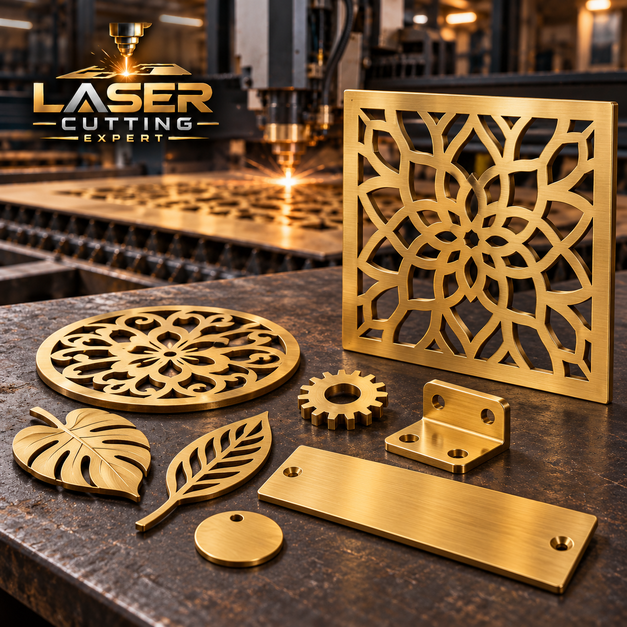
Brass is usually chosen because the metal itself is meant to be seen. Its warm gold-toned appearance works particularly well for decorative products, interior details, nameplates, branding pieces, jewellery components and bespoke metalwork. At Laser Cutting Expert, we manufacture custom brass parts from our London workshop for designers, jewellers, architects, product makers, businesses and individual customers. Our work ranges from larger decorative profiles to small laser cut brass jewelry components requiring carefully prepared artwork. Customers can order one prototype, several variations or repeat batches without a minimum cutting quantity. We can work from production-ready CAD files, assist with suitable cutting artwork and source brass sheet according to project requirements.
CALL OR EMAIL US FOR PRICES
“Order any time of the day or night and receive your order on the same day in London. You are welcome to visit our laser cutting shop for an instant laser cutting service. On-site collection or free delivery can be arranged. Email us at laser@makergroup.uk for a quick quote or call us on 02036339857 for an instant price”.
Same Day Laser Cutting & Delivery
We can arrange a same day courier delivery with customer live tracking. Or customers can collect from our Laser Cutting Expert shop.
OPEN 24 HOUR
We are open 7 days a week, and you can order at any time. There is no last ordering time and no deadline. We also offer an overnight laser cutting service.

100% Satisfaction
High Quality Laser Cutting & 100% Customer Satisfaction Guarantee. Top-Rated Laser Cutting Company on Google.

Free File Check
We offer a free file check and proof before sending your artwork for laser cutting.
Brass Projects Start with the Visible Face
With many engineering parts, surface appearance is secondary to dimensions. Brass is different. The face, grain, reflections and eventual patina can be part of the finished design, so material handling needs to be considered from the beginning. Customers should tell us whether the component will be polished, brushed, coated, engraved or allowed to age naturally after cutting. Protective film and sheet condition can also matter on highly visible pieces. If components are going into an interior where several brass parts sit next to each other, material consistency becomes particularly important. Establishing the intended finish early helps avoid treating a decorative brass product like an ordinary hidden fabrication component.
Laser Cut Brass Jewelry
Fine laser cut brass jewelry can be developed from geometric artwork, initials, symbols, botanical patterns and original illustrations. Earrings, pendants, charms and other suitable jewellery components can be produced as individual pieces or matching pairs. At this scale, small differences in geometry matter. Attachment holes need enough surrounding metal, narrow sections must remain strong enough for handling and sharp points may require adjustment. Weight should also be considered when developing larger earrings or pendants. We manufacture the laser-cut components to supplied or approved artwork, while skin-contact suitability, findings, coatings and final jewellery-product compliance remain the responsibility of the jewellery designer or finished-product manufacturer.
Matching Pairs and Mirrored Jewellery Components
Jewellery frequently needs components to be produced as pairs rather than simply duplicated. Earrings may need mirrored orientation, while left- and right-facing decorative elements can form part of a larger design. We can prepare suitable cutting layouts so paired components remain organised during production. This becomes especially helpful when one sheet contains several jewellery designs in different sizes. Small holes for hooks, chains or jump rings can be included where technically suitable. The actual fitting dimensions should be confirmed before the hole is finalised. For new jewellery collections, producing a few sample pairs first allows the designer to check scale, weight and hanging orientation before ordering more.
Brass Nameplates and Identification Pieces
Brass has long been associated with plaques and nameplates because lettering contrasts well against its distinctive metal surface when the correct finishing method is used. We can manufacture custom brass profiles for office doors, furniture, equipment, displays and suitable commemorative applications. Outside shapes and mounting holes can be laser cut while names, numbers or logos can be added using an appropriate complementary process. Customers should specify whether the brass will remain natural, polished, brushed or receive another finish after manufacture.
Brass for Luxury Retail and Hospitality Interiors
London’s hotels, restaurants, boutiques and premium retail spaces often use brass as a visual detail rather than as the main structural material. Small trims, branded plaques, menu details, display components and decorative inserts can introduce a metallic accent without requiring an entire installation to be manufactured from brass. We work with interior designers, shopfitters and fabrication businesses producing these types of custom components. Projects in areas such as Mayfair, Knightsbridge, Chelsea, Soho and the City may also require replacement or additional pieces after the original installation. With no minimum quantity, one matching component can be produced without recreating a full commercial production run.
Brass Logos and Brand Components
A company logo cut from real brass creates a different finish from gold-coloured printed graphics or plastic. Suitable logos can be manufactured as individual letters, connected emblems or components intended for mounting onto another surface. Artwork often needs some preparation before cutting because very narrow strokes that work perfectly in digital branding may be fragile as physical metal. Disconnected parts also need to be considered during installation. An alignment template can help position individual letters accurately on a wall, counter or display. For smaller logos, engraving or a simplified profile may produce a more practical result than attempting to reproduce every tiny feature as a separate cut component.
Decorative Brass Panels and Inserts
Brass sheet can be cut into decorative inserts for furniture, cabinetry, wall features and display systems. Patterns may be geometric, botanical, art-deco inspired or created specifically for a particular interior. Removing large areas of material changes panel rigidity, so decorative artwork needs to leave suitable connections between features. The supporting structure should also be established before the panel is manufactured. A brass insert held inside a rigid frame behaves differently from a free-standing sheet. For large architectural or load-related applications, the responsible designer or engineer should specify material thickness, fixing and structural requirements. We manufacture the cut geometry according to the approved production information.
Brass Components for Furniture and Cabinetry
Small brass components can add both function and visible detail to furniture. Suitable plates, escutcheon-style profiles, inserts, trim pieces and decorative components can be cut from sheet according to the furniture designer’s drawings. Fixing-hole positions should be coordinated with the underlying timber or furniture structure rather than added visually at the end. If a part will be recessed into a surface, the receiving pocket and brass component should be designed together with appropriate clearance. We can produce one prototype for a custom furniture commission or repeat matching pieces for a collection. Consistent material specification is useful where several visible components need to appear together.
Brass Components for Signs and Displays
Brass can be used for directional details, lettering, plaques and decorative sign components where the metal finish is part of the design. Unlike painted sheet, unfinished brass naturally changes with handling and exposure, which may be intentional or may require a protective finishing strategy. Customers should decide whether they want a bright polished appearance or are comfortable with gradual patination. Individual letters can include positioning information or be supplied with an installation template where appropriate. For public-facing signage, readability should remain the priority; extremely thin decorative fonts may need strengthening before they can be manufactured reliably as separate metal characters.
Brass Prototypes for Product Designers
Brass is also useful for product development where the final item needs to be evaluated in its real material rather than represented by a plastic prototype. A designer can check weight, surface appearance, proportions and interaction with other components before committing to a larger quantity. We can manufacture one-off development parts without requiring production-volume orders. If changes are needed, the CAD drawing can be revised and another version cut. Once approved, the file can become the controlled production version for future batches. This is useful for hardware, decorative accessories, branded products and other small metal items where visual appearance matters as much as basic geometry.
Fine Detail in Brass Cutting
Detailed brass work needs to be assessed at its actual finished size. A decorative pattern that appears strong at 300 mm wide may become fragile when reduced to 30 mm for a piece of jewellery. Narrow bridges, small internal openings and sharp corners should all be reviewed in relation to sheet thickness. Very fine holes can also be difficult or inappropriate depending on the material and process. Rather than forcing every digital detail into the metal, simplifying selected areas can often produce a stronger and cleaner physical product. We can review suitable artwork for manufacturability before production, particularly where the design contains intricate lettering or repeating decorative geometry.
Polished, Brushed and Natural Brass Appearance
The same cut component can look very different depending on how its surface is finished. Polished brass gives a brighter reflective appearance, while brushing produces a more directional, subdued surface. Natural unfinished brass can gradually develop patina through air, moisture and handling. This change is a normal characteristic of the material rather than necessarily a manufacturing defect. Protective coatings may be considered where the designer wants to preserve a particular appearance. Customers arranging finishing elsewhere can order the components as cut profiles. If the final appearance is especially important, the intended finishing route should be established before the production material is selected.
Patina as Part of the Design
Not every customer wants brass to remain bright. Some interiors and decorative products deliberately use aged or patinated surfaces. Because brass naturally changes over time, designers can choose to work with that characteristic instead of trying to eliminate it. The final result can vary depending on environment, handling and any chemical finishing process used afterwards. Laser cutting establishes the component geometry, while patination can be carried out as a separate finishing stage where appropriate. If pieces need to age visually as a matching set, consistent starting material and finishing treatment become important. Customers should also consider whether fingerprints and handling marks are acceptable on exposed natural brass.
Material Thickness, Alloy and Component Size
Brass is available in different grades and thicknesses, and the correct choice depends on the product. Thin sheet can suit lightweight decorative pieces and jewellery, while larger panels may require additional thickness or supporting construction. Increasing thickness also increases weight, which can become important on wall-mounted pieces and wearable products. The selected grade may influence forming and finishing behaviour. Customers with a specific technical requirement should provide the material specification on the drawing. Where the project is primarily decorative, we can discuss suitable available stock based on the required appearance, dimensions and manufacturing process.
Expert Technical Overview – Brass Laser Cutting
With laser cut brass jewelry, minimum feature width, attachment-hole position and finished weight need to be considered together. Thin decorative sections can bend or become vulnerable during handling even when they can technically be cut. Larger brass panels require attention to rigidity, mounting and the amount of material removed by the pattern. Brass is also reflective and thermally conductive, so the cutting setup must match the material and thickness. Visible components should be planned around the intended surface finish because polishing, brushing and patination can change their appearance significantly. For repeat batches, controlled material specifications and approved CAD revisions help maintain consistency between production runs.
Design for Finishing, Not Just Cutting
The laser-cut profile is often only the beginning of a brass product. If an edge will later be polished, enough material and access may be needed for finishing. If the component will be bent, the flat pattern should account for the forming process. If a logo will be mounted individually, positioning needs to be solved before installation. Jewellery may require additional edge finishing before it is suitable for wear. Thinking through these later stages at the drawing stage reduces unnecessary reworking. Where suitable metal components need forming, our related page Laser Cut Custom Designs.
Same Day Brass Laser Cutting London
Suitable brass projects can be produced urgently from our London workshop when the required sheet and production-ready artwork are available. This can include a missing interior component, jewellery prototypes needed for a presentation, replacement brass lettering or a small batch required for an event or product launch. We operate 24/7, including weekends and bank holidays, and there is no minimum cutting quantity. Same-day London courier delivery can be arranged for qualifying completed work. More involved projects requiring extensive artwork preparation, specialist material or additional finishing may need longer, while next-day UK delivery is available for many completed orders.
Brass Laser Cutting Near Me
Laser Cutting Expert provides brass cutting from our in-house London production facility for customers across the capital and throughout the UK. Jewellers, product designers, interior studios, furniture makers, sign businesses and individuals can send CAD or vector artwork remotely. We can manufacture a single prototype, matching pair, replacement component or repeat production batch without imposing a minimum quantity. Customers may also supply their own identified brass sheet where it is compatible with our equipment. Suitable urgent London projects can be cut and delivered on the same day, while completed orders can be dispatched quickly to customers elsewhere in the UK.
FAQs About Brass Laser Cutting
1. Can you produce one brass jewellery prototype?
Yes. There is no minimum quantity, so one pendant, pair of suitable components or development sample can be produced before a larger order.
2. Can you cut very detailed brass designs?
Yes, within practical limits. Minimum feature size depends on the material thickness, geometry and cutting process, so intricate artwork should be reviewed at final size.
3. Can you cut brass logos and letters?
Yes. Suitable logos, lettering and individual brand components can be produced from vector or CAD artwork.
4. Does brass change colour over time?
Natural brass can develop patina through exposure and handling. Polishing, protective finishing or intentional patination can be used depending on the required appearance.
5. Can I provide my own brass sheet?
Yes, subject to confirming the material specification, dimensions and compatibility with our equipment.
6. Can brass components be produced on the same day?
Suitable London projects may qualify for same-day cutting when the material, artwork and workshop capacity allow.
7. Can you make brass components that will be bent afterwards?
Yes. Suitable flat patterns can be cut for subsequent forming, and cutting and bending can be combined for appropriate projects.