
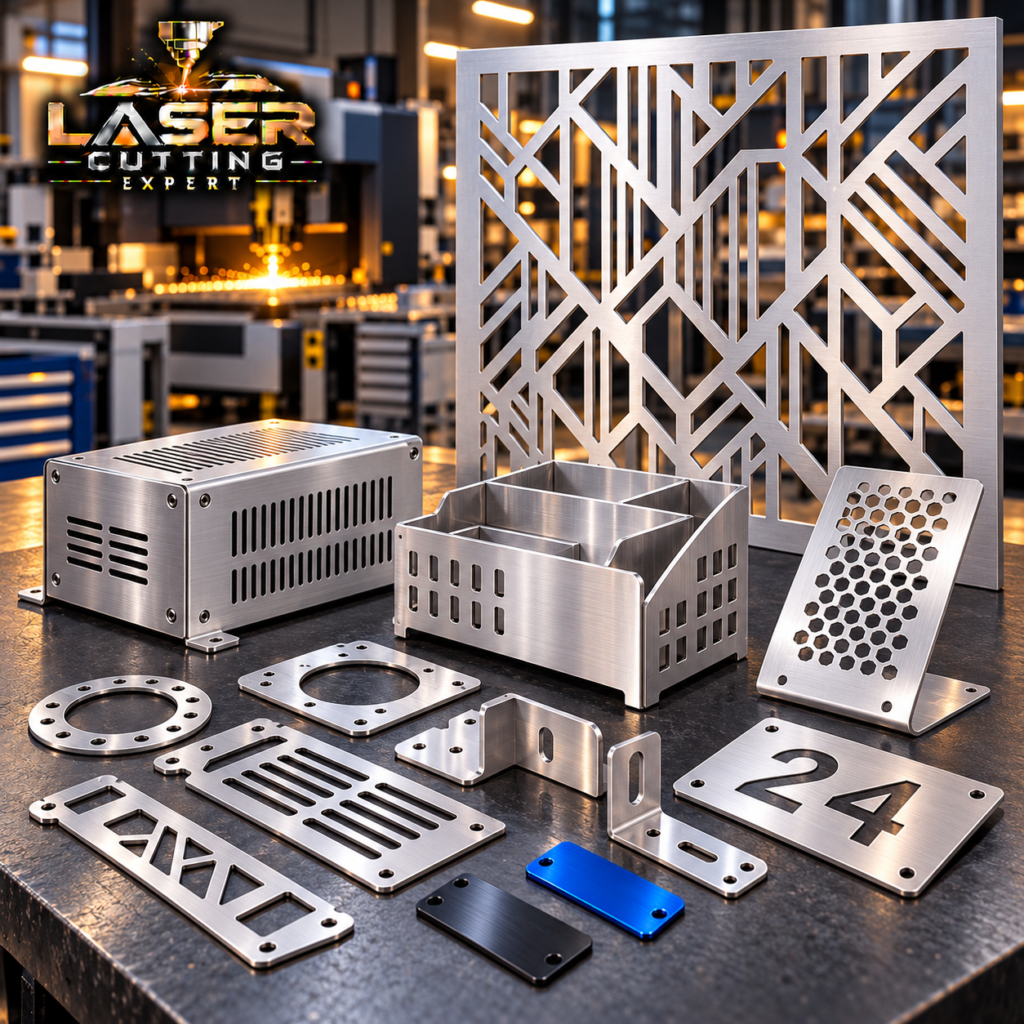
Aluminium is often selected when a finished metal component needs useful strength without the weight of steel. That makes it practical for enclosures, covers, brackets, equipment panels, displays, architectural details and many fabricated products. At Laser Cutting Expert, we manufacture aluminium components and laser cut aluminum panels from our London workshop for engineers, fabricators, product designers, contractors and individual customers. We work from CAD drawings to produce prototypes, replacement pieces, short batches and repeat components with no minimum cutting quantity. Suitable parts can also move into bending and further finishing after profile cutting. Customers may supply identified aluminium sheet or ask us to source material for the project.
CALL OR EMAIL US FOR PRICES
“Order any time of the day or night and receive your order on the same day in London. You are welcome to visit our laser cutting shop for an instant laser cutting service. On-site collection or free delivery can be arranged. Email us at laser@makergroup.uk for a quick quote or call us on 02036339857 for an instant price”.
Same Day Laser Cutting & Delivery
We can arrange a same day courier delivery with customer live tracking. Or customers can collect from our Laser Cutting Expert shop.
OPEN 24 HOUR
We are open 7 days a week, and you can order at any time. There is no last ordering time and no deadline. We also offer an overnight laser cutting service.

100% Satisfaction
High Quality Laser Cutting & 100% Customer Satisfaction Guarantee. Top-Rated Laser Cutting Company on Google.

Free File Check
We offer a free file check and proof before sending your artwork for laser cutting.
Aluminium Is More Than a Lightweight Alternative to Steel
Choosing aluminium should be a design decision rather than simply replacing steel with a lighter sheet of the same thickness. Different aluminium alloys have different strength, forming and finishing characteristics. A thin aluminium cover may be perfectly suitable for an enclosure but inappropriate for a heavily loaded bracket. Likewise, a grade selected for bending may be preferable to another alloy for a fabricated product. Before cutting, we need to understand the required grade, thickness, dimensions and what happens to the component afterwards. If a customer already has an engineering specification, we manufacture from that information rather than making assumptions based only on the word “aluminium.”
Laser Cut Aluminum Panels
Custom laser cut aluminum panels can be manufactured for machinery, equipment, architectural projects, displays, interiors and fabricated products. Panels can contain mounting holes, ventilation openings, access cut-outs, cable routes, slots and other suitable features directly from the CAD file. This reduces the need to manually mark and produce every opening after the outside profile has been made. Large decorative patterns can also be incorporated where appropriate. Panel rigidity should be considered carefully because removing significant material changes how the sheet behaves. Where a large panel requires additional stiffness, folded edges, returns, framing or another supporting construction may need to form part of the final design.
Aluminium Control and Equipment Panels
Equipment panels often contain a combination of large openings and small accurately positioned features. Displays, switches, connectors, ventilation areas and mounting screws may all need to align with components behind the sheet. We can manufacture suitable aluminium front panels, covers and equipment faces directly from supplied production drawings. Customers should identify any dimensions that control alignment with existing hardware. Electrical and equipment compliance remains the responsibility of the manufacturer responsible for the complete assembled product.
Lightweight Aluminium Components for Fabrication
Reducing component weight can matter in portable equipment, displays, transport-related products and structures containing many repeated parts. Aluminium allows designers to reduce weight while retaining a metal construction, provided the selected alloy and thickness are appropriate for the application. We can cut brackets, plates, covers, gussets, spacers and other suitable flat components for subsequent fabrication. Tabs, slots and locating features can be included to help pieces align during assembly. Where a component is load-bearing or safety-critical, material grade and dimensions should be specified and validated by the responsible engineer rather than selected solely to achieve the lowest possible weight.
Aluminium Panels for Interiors and Displays
Aluminium can provide a clean metal finish without the mass associated with thicker steel panels. This makes it useful for suitable retail displays, exhibition systems, decorative interior features and branded installations. Panels can use straightforward geometric perforations or more individual artwork developed around a particular interior. For patterned pieces, open-area percentage and remaining bridge widths influence both appearance and rigidity. Mounting holes can be included in the cutting file so the panel arrives prepared for the intended installation method. If the finished surface will be visible, customers should also decide early whether the component will remain as-cut or receive brushing, coating, anodising or another appropriate finish afterwards.
Aluminium Enclosures and Covers
A flat laser-cut aluminium sheet can become part of an enclosure after bending. Cut-outs for fans, switches, displays, connectors and cable entry can be positioned before the part reaches the forming stage. This can be more controlled than attempting to add all features after the enclosure has already been folded. The flat pattern must account for the intended bend positions and finished dimensions. Hole placement close to bend lines also needs careful consideration because forming can distort nearby features. Suitable projects can move from profile cutting into our related page Laser Cut Custom Designs, allowing the cutting and forming stages to be planned as one manufacturing sequence.
Aluminium Brackets and Mounting Plates
Brackets and mounting plates may look simple, but their hole locations often control the position of other equipment. For that reason, critical dimensions should be identified clearly on the production drawing. Components can be produced with round holes, slots, notches and custom outside profiles. Slotted holes can provide adjustment where appropriate, while locating tabs may help during fabrication. If the bracket will be bent after cutting, the material grade and temper should be suitable for forming. For prototype equipment, one bracket can be manufactured first and checked against the actual assembly before additional pieces are ordered. There is no requirement to commit immediately to a larger batch.
Ventilation and Perforated Aluminium Panels
Ventilation panels need to balance airflow with material strength. Simply adding as many holes as possible can leave a panel flexible and may create unnecessary cutting time. Hole diameter, slot width, spacing and pattern arrangement should instead be designed around the required airflow and the structural role of the panel. Very small features in relatively thick material may also be unsuitable or inefficient to produce. We can manufacture custom ventilation layouts from supplied drawings for equipment housings, cabinets and other appropriate products. The equipment designer remains responsible for determining the ventilation area needed for safe thermal performance of the complete system.
Decorative Aluminium Screens and Panels
Aluminium can also be used where the cutting pattern is intended to be seen. Geometric artwork, abstract designs, branding and other suitable patterns can be incorporated into interior or architectural panels. Large decorative pieces need enough connected material to remain manageable during transport and installation. Pattern scale should therefore be considered alongside sheet thickness and overall dimensions. Exterior projects may require additional attention to wind exposure, fixing method and surface finish. We manufacture panels from approved designs, while structural loading and installation requirements should be determined by the responsible designer, engineer or contractor where the finished product forms part of a building or permanent installation.
Aluminium Parts for Prototypes and Product Development
Aluminium is frequently used during product development because it can provide a realistic metal prototype without requiring mass-production tooling. Designers can test an enclosure, mounting plate or panel in the actual assembly and then revise the CAD file after discovering what needs to change. A connector opening may move a few millimetres, a fixing slot may become longer or a cover may need additional ventilation. We can manufacture the revised version without requiring a large minimum quantity. Once the design is approved, the same production file can support low-volume or repeat manufacture, with revision references helping ensure that obsolete prototypes are not accidentally reordered.
Sheet Thickness, Alloy and Material Specification
“Aluminium sheet” is not a complete production specification. The alloy, temper and thickness can influence strength, bending behaviour, surface appearance and suitability for the final product. Customers with engineering drawings should include the required material specification wherever it matters. Sheet thickness should also be selected around the finished component rather than laser cutting alone. A large flat panel may need additional rigidity, while a small cover could become unnecessarily heavy if over-specified. For repeat production, using a consistent material specification helps maintain predictable fabrication results. We can discuss suitable available stock, but final material selection for engineered applications should follow the customer’s design requirements.
Expert Technical Overview – Aluminium Laser Cutting
For laser cut aluminum panels, the drawing should account for material grade, thickness, minimum feature size and the amount of material remaining around openings. Thin aluminium sheets can be sensitive to heat and movement during processing, while large panels may lose rigidity when extensive patterns or ventilation areas are removed. Holes close to later bend lines can also distort during forming. Aluminium’s reflective and thermal properties mean the cutting process must be appropriate to the specific sheet and thickness. Where components require tight fits, tolerances should be stated explicitly. A first-off component can then be inspected before a larger batch enters production.
Flatness Matters on Large Panels
A panel can be dimensionally accurate around its perimeter but still cause problems if flatness is ignored. Large thin sheets may flex naturally, while extensive cutting can change the distribution of stress within the material. If a panel is intended to sit visibly against a flat frame, cabinet or wall, the supporting method should be considered during design. Folded returns can sometimes provide stiffness, while strategically positioned fixings can help control the finished installation. Increasing material thickness is another option, although it adds weight and cost. The right solution depends on the panel dimensions, pattern and final mounting arrangement rather than one universal thickness rule.
Designing Aluminium Parts for Bending
When a laser-cut aluminium component will be folded, the cutting drawing should normally represent the correct developed flat pattern. Bend radius, material thickness and the forming method influence where the finished edges and holes will end up. Features positioned very close to a bend can stretch or distort. Different alloys can also behave differently during forming, particularly around tight bends. For this reason, the bending stage should be considered before the profile is cut rather than treated as an unrelated operation afterwards. We can handle suitable cut-and-bend projects or supply the correctly prepared flat components for forming in the customer’s own fabrication workshop.
Surface Finish After Cutting
The appearance required from a finished aluminium product should be established early because subsequent finishing may influence material handling and design. Components may be left in an appropriate as-cut state or prepared for processes such as powder coating, anodising, brushing or other suitable finishes carried out according to the project requirements. Visible faces should be protected from unnecessary handling where possible. If a component is going to be coated, holes and mating surfaces may need to account for the final finish thickness in particularly close-fitting assemblies. Customers arranging their own finishing can order the cut aluminium parts from us as unfinished fabrication components.
Same Day Aluminium Laser Cutting London
Suitable urgent aluminium projects can be produced through our same-day London service when the required material is available and the CAD file is ready for manufacture. This can be useful when a fabricator is missing a panel, a prototype needs to be ready for a client meeting or an equipment cover has changed late in the build. Our London workshop operates 24/7, including weekends and bank holidays. There is no minimum cutting quantity. Qualifying completed components can be delivered across London by same-day courier, while next-day UK delivery is available for many orders once cutting and any requested secondary work have been completed.
Aluminium Laser Cutting Near Me
Laser Cutting Expert manufactures aluminium parts in-house from our London production facility for customers across the capital and throughout the UK. Engineers, fabricators, designers and businesses can send CAD drawings remotely along with material, thickness and quantity requirements. We accept one-off prototypes, replacement panels, low-volume components and repeat production without imposing a minimum order. Customers can also provide their own identified aluminium stock where it is suitable for our equipment. For urgent London projects, same-day cutting and delivery may be possible. UK-wide orders can be dispatched for fast delivery after the required manufacturing and finishing stages are complete.
FAQs About Aluminium Laser Cutting
1. Can you laser cut a single aluminium panel?
Yes. There is no minimum order, so one prototype, replacement panel or custom component can be manufactured.
2. Can you add holes and ventilation slots during cutting?
Yes. Suitable holes, slots, access openings and ventilation patterns can be incorporated directly into the CAD cutting file.
3. Can aluminium parts be bent after laser cutting?
Yes. Suitable aluminium components can be designed for subsequent forming, and we can provide cutting and bending for appropriate projects.
4. Can I supply my own aluminium sheet?
Yes, subject to confirming the alloy, thickness, dimensions and suitability for our equipment.
5. Can you produce decorative aluminium panels?
Yes. We can manufacture suitable custom patterns for interior, display and architectural applications from production-ready artwork.
6. Can aluminium parts be made on the same day?
Suitable London projects can qualify for same-day production depending on material availability, quantity, thickness, dimensions and file readiness.
7. Do I need to specify the aluminium alloy?
For engineered or fabrication components, yes. The correct alloy and temper can affect strength, bending and finishing, so they should be specified where important.