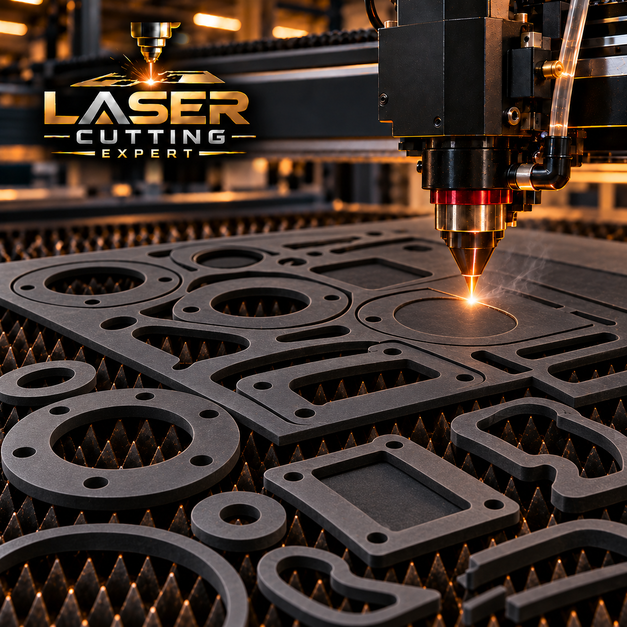
Rubber parts often look simple on a drawing: a ring, gasket, pad, strip or custom profile. In practice, the material can stretch, compress and recover, which means the finished component has to be considered differently from a rigid metal or plastic part. At Laser Cutting Expert, we laser cut rubber from suitable identified sheet materials for prototypes, gaskets, seals, protective pads, spacers and custom components. Production is handled from our London workshop with no minimum quantity. Customers can provide their own suitable rubber sheet or ask us to source material. For appropriate jobs, same-day London service and delivery can be arranged, with next-day UK delivery options also available.
CALL OR EMAIL US FOR PRICES
“Order any time of the day or night and receive your order on the same day in London. You are welcome to visit our laser cutting shop for an instant laser cutting service. On-site collection or free delivery can be arranged. Email us at laser@makergroup.uk for a quick quote or call us on 02036339857 for an instant price”.
Same Day Laser Cutting & Delivery
We can arrange a same day courier delivery with customer live tracking. Or customers can collect from our Laser Cutting Expert shop.
OPEN 24 HOUR
We are open 7 days a week, and you can order at any time. There is no last ordering time and no deadline. We also offer an overnight laser cutting service.

100% Satisfaction
High Quality Laser Cutting & 100% Customer Satisfaction Guarantee. Top-Rated Laser Cutting Company on Google.

Free File Check
We offer a free file check and proof before sending your artwork for laser cutting.
Rubber Selection Starts with the Application
The correct rubber is determined by what the finished component needs to withstand. Temperature, oils, water, chemicals, outdoor exposure, compression and repeated movement can all influence material choice. A general protective pad and an engineering seal may look similar but need completely different rubber specifications. Before we laser cut rubber sheet, customers should identify the material grade and intended application, particularly for technical parts. Cutting controls the shape of the component; it does not change the underlying performance of the rubber. Where a part has critical sealing, chemical-resistance or temperature requirements, those properties should be established by the responsible engineer or manufacturer before production begins.
Custom Gaskets from Rubber Sheet
Gaskets are one of the most common flat rubber components because they can be manufactured directly from a two-dimensional drawing. Circular gaskets, flange profiles, rectangular seals and irregular equipment gaskets can include bolt holes and internal openings within the same design. We laser cut rubber for suitable prototype and low-volume gasket applications where the material itself is compatible with laser processing. Accurate CAD geometry is important, but material compression must also be considered when specifying dimensions. For safety-critical pressure systems, gas installations or regulated equipment, gasket grade, thickness and design should always be selected and validated by the responsible engineer rather than determined solely by the cutting method.
Seals for Covers, Panels and Enclosures
Rubber seals can sit between two components to reduce movement, close gaps or help protect an enclosure from its surrounding environment. Suitable sheet profiles can be manufactured for equipment covers, access panels, cases and prototype assemblies. When we laser cut rubber sheet, holes and openings can follow the mating component rather than relying on standard seal dimensions. However, successful sealing depends on more than the outside profile. Compression, surface condition, fixing pressure and material hardness all contribute. If a finished assembly needs a defined IP rating, pressure rating or environmental certification, that performance must be tested and verified at product level by the responsible equipment manufacturer.
Silicone Rubber Requires Material Confirmation
Laser cutting silicone rubber needs specific assessment because silicone products are available in many formulations, colours, hardness levels and reinforcement constructions. Some sheet may be plain silicone, while other products can contain fabric reinforcement, adhesives or additional layers. We therefore ask customers to provide the material specification before processing. Suitable silicone rubber is often selected for applications involving temperature resistance, flexibility or repeated compression, but those performance characteristics come from the material grade rather than the cutting process. If the silicone component is intended for medical, food-contact, electrical or other regulated use, the customer must specify appropriately certified material and validate the completed product for that application.
Rubber Washers and Ring-Shaped Components
Washers do not always need to be metal. Rubber rings and washer-shaped components can provide cushioning, spacing, vibration reduction or surface protection between assembled parts. We can laser cut rubber into circular and custom washer profiles with different outside diameters, internal holes and thicknesses according to the supplied drawing. Multiple washer sizes can also be arranged on one sheet, which is useful for prototype sets and mixed small batches. Very narrow rings need enough material between the inside and outside diameter to remain stable during handling. Where the washer performs a critical sealing or load-related function, its dimensions and material properties should be specified by the responsible product designer.
Protective Pads and Surface Contact Pieces
Rubber pads can prevent hard components from contacting one another directly. They may sit beneath equipment, furniture, brackets, covers or machinery to provide cushioning or protect a finished surface. Laser cut rubber sheet allows these pads to follow unusual product shapes instead of being limited to standard circles and rectangles. Holes, slots and cut-outs can also be included where the pad needs to locate around fixings. Material hardness and thickness influence how much the component compresses under load. For heavy equipment or vibration-control applications, the responsible engineer should specify the rubber properties required rather than assuming any flexible sheet will provide the necessary performance.
Vibration and Noise-Control Components
Rubber is commonly placed between rigid parts where vibration or impact needs to be reduced. Suitable custom pieces can include mounting pads, separator strips, equipment feet and isolation layers. We laser cut rubber to the specified geometry, allowing mounting holes and equipment profiles to be included directly in the part. The effectiveness of vibration isolation, however, depends on material hardness, thickness, load, frequency and the complete mounting arrangement. Cutting alone does not turn ordinary rubber into a rated vibration-control product. For engineering applications, material and design requirements should therefore come from the responsible engineer. We can then manufacture suitable sheet components according to the approved dimensions.
Rubber Components for Machinery
Machinery often contains simple flat components that are easy to overlook until a replacement is needed. Rubber covers, pads, separators, flexible strips and non-critical gasket profiles can sometimes be reproduced from CAD drawings or measured samples. Our laser cut rubber sheet service is useful for suitable one-off replacement parts and short production runs because there is no need for dedicated cutting dies. If an original component has stretched, compressed or deteriorated, dimensions should ideally be taken from the equipment specification rather than copying the damaged piece exactly. Material identification is equally important, particularly where the component is exposed to oil, heat, chemicals or continuous mechanical movement.
Rubber for Cases and Product Protection
Cases and packaging can use rubber components where a tougher or more flexible contact surface is needed than conventional foam provides. Suitable pieces may include protective pads, corner profiles, spacers and equipment supports. We can laser cut rubber according to the product or case dimensions, allowing repeated components to be manufactured consistently. Rubber can also be combined with foam, plastic or metal parts in a larger protective assembly. The material should be selected according to the weight of the product and expected environment. For delicate equipment, a physical prototype is useful because the designer can check whether the rubber provides the intended support before ordering additional case components.
Rubber Spacers and Assembly Components
A spacer may need to maintain separation between two surfaces while still allowing a degree of compression. Flat rubber spacers can be manufactured in circular, rectangular or completely custom profiles. With laser cut rubber sheet, several spacer sizes can be nested onto one sheet for prototypes or maintenance kits. Internal holes can accommodate bolts, cables or other assembly features. The finished thickness under compression may differ from the uncompressed sheet thickness, so designers should account for this where spacing is dimensionally important. Our related High Volume & Contract Laser Cutting service can support suitable projects where smaller custom profiles need to be produced consistently from digitally supplied geometry.
Rubber for Automotive Development Work
Automotive development projects can require rubber pads, prototype gaskets, separators and protective components for interior, body or equipment testing. Laser cutting can be useful for suitable flat development pieces because the CAD profile can be changed quickly between versions. However, vehicle applications vary greatly in risk. A decorative interior pad is very different from a seal used in a fuel, braking or safety-critical system. We can laser cut rubber for suitable identified materials and approved drawings, but the vehicle designer or engineer remains responsible for material compatibility, durability and safety validation. Production method alone cannot confirm that a component is suitable for road or motorsport use.
Electronics and Electrical Equipment
Rubber sheet can be used for protective pads, insulating separators, enclosure seals and mounting components in electronic equipment. The exact rubber formulation matters because not all rubber has the same electrical behaviour, temperature resistance or flame performance. When we laser cut rubber sheet for electrical projects, customers should specify any required dielectric, fire-retardant or environmental properties. We manufacture the geometry but do not infer electrical certification from the appearance of the material. Where a component needs to comply with a particular standard, appropriately specified material should be supplied or selected first. The complete equipment should then be validated by the responsible electrical product manufacturer.
Prototyping Flexible Components
Flexible components can be difficult to judge entirely from CAD because the real material changes shape under pressure. A prototype lets designers test fit, compression and handling before moving into repeat production. Our no-minimum-order service allows one laser cut rubber component to be produced for checking before a larger batch is ordered. This works well for gaskets, pads, separators and product-development pieces. If dimensions need changing, the CAD drawing can be adjusted without manufacturing a physical die. Once the material, thickness and geometry have been approved, the same digital file can be used for further production, helping maintain consistency across replacement parts or repeated assemblies.
Adhesive-Backed Rubber
Some rubber products are supplied with pressure-sensitive adhesive backing so the finished component can be positioned directly onto another surface. These materials require additional checks because both the rubber and adhesive system need to be compatible with the selected cutting process. Release liners and other backing layers also need identification. We do not assume that adhesive-backed laser cut rubber sheet is suitable simply because the rubber layer itself can be processed. Customers should provide the complete material specification where possible. For suitable products, adhesive-backed pads, strips and custom profiles can simplify later assembly by eliminating a separate manual adhesive application stage.
Reinforced and Multi-Layer Rubber Sheet
Industrial rubber sheet may contain fabric reinforcement, multiple polymer layers or specialist surface treatments. These materials can behave very differently from plain homogeneous rubber. A reinforced gasket sheet, for example, cannot be assessed simply by measuring its thickness. Each layer needs to be understood before processing. Customers requesting laser cut rubber from specialist sheet should therefore provide manufacturer information or a safety data sheet where available. If reinforcement or another layer is unsuitable for laser processing, an alternative cutting method may be required. Material identification is particularly important for older replacement parts where the original sheet specification may no longer be immediately obvious.
What Happens at the Cut Edge
Laser processing uses heat, so the edge of rubber may not look exactly like a mechanically cut edge. Depending on the polymer, thickness and formulation, there can be darkening, slight melting, residue or other thermal effects. The acceptable result depends on whether the part is hidden inside equipment or used as a visible finished component. When we laser cut rubber sheet, we assess the material and required edge before committing to a larger batch. Sample testing can be particularly useful for customer-supplied sheet. If the required edge quality cannot be achieved reliably with a laser, another production method may be more appropriate for that particular material.
Material Safety Comes Before Cutting
Rubber products can contain fillers, plasticisers, flame retardants and other additives that are not obvious from appearance. Some rubber-like materials may also contain chlorine or other substances unsuitable for laser processing. We therefore do not cut unidentified sheet simply because it feels like rubber. PVC and chlorine-containing materials are excluded because laser heat can generate hazardous and corrosive gases. This same caution applies to laser cutting silicone rubber when the complete material formulation is unknown. Supplier documentation, product specifications or safety data may be requested before processing. Identifying the material protects operators, equipment and the customer’s finished parts from unnecessary risk.
Technical Notes for Rubber Laser Cutting
Rubber cutting depends on polymer type, hardness, thickness, fillers and thermal response. Flexible sheet can move or distort differently from rigid material, while heat may affect the edge around small holes and narrow profiles. When we laser cut rubber, the CAD dimensions should account for the function of the finished component rather than only its uncompressed shape. Laser cutting silicone rubber requires confirmation of the exact formulation, and reinforced sheet needs additional assessment. For gaskets and seals, material performance under compression, temperature and chemical exposure remains separate from cutting accuracy. Safety-critical sealing products should always be validated by the responsible engineer or equipment manufacturer.
Same Day Rubber Components in London
Urgent replacement gaskets, prototype pads and flexible components are sometimes needed to keep a project moving. Our London workshop operates 24/7, including weekends and bank holidays, so suitable laser cut rubber sheet jobs can be considered for same-day production when material and artwork are ready. Customer-supplied rubber is accepted where the composition is identified and compatible with laser processing. We can also help source suitable material for appropriate applications. There is no minimum quantity, so urgent work can consist of a single component. Same-day courier delivery is available across London for suitable completed orders, with next-day UK delivery options available depending on production requirements.
Rubber Laser Cutting Across the UK
Laser Cutting Expert works with engineers, manufacturers, designers, maintenance teams, students and private customers throughout the UK. Send us the material specification, thickness, dimensions, quantity and CAD file so we can assess the job. If you need laser cut rubber but only have measurements or an existing design that needs preparing for production, our team can help with the cutting file. One-off prototypes, replacement pieces, mixed component sets and repeat batches are all welcome. Production takes place in London, with suitable urgent local work available for same-day delivery and completed orders dispatched to customers elsewhere in the UK using appropriate delivery services.
FAQs About Rubber Laser Cutting
1. What rubber products can you laser cut?
Suitable applications include gaskets, seals, pads, washers, spacers, separators, protective components and prototype parts.
2. Can you laser cut silicone rubber?
Laser cutting silicone rubber can be assessed where the exact material formulation is known and compatible with the process.
3. Can I provide my own rubber sheet?
Yes. Customer-supplied material is welcome, but we need to know its composition. Unknown or chlorine-containing rubber-like materials cannot be laser processed.
4. Can you produce custom rubber gaskets?
Yes. We can laser cut rubber sheet into suitable gasket profiles from CAD drawings, including holes and custom internal openings.
5. Can you cut adhesive-backed rubber?
Potentially, but both the rubber and adhesive system must be identified and confirmed as suitable for laser processing.
6. Can you make one prototype?
Yes. There is no minimum order, so we can produce a single suitable prototype before you proceed with repeat production.
7. Do you offer same-day rubber cutting?
Suitable identified materials and production-ready designs can be considered for same-day cutting from our London workshop, subject to the job requirements.