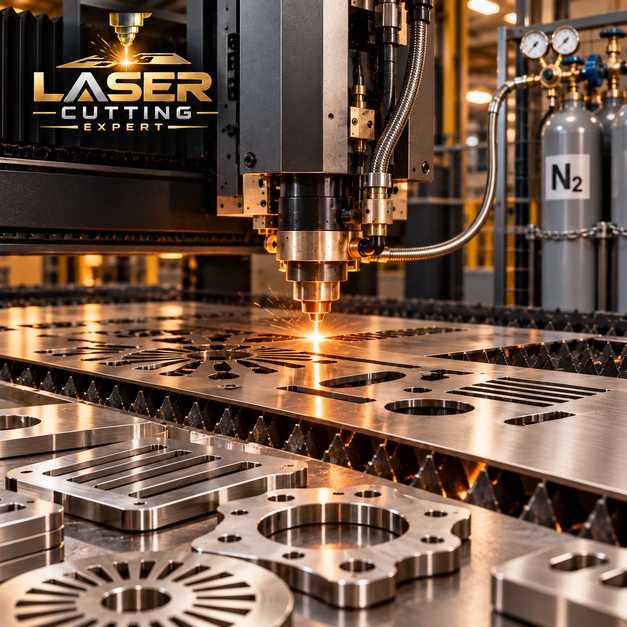
The laser provides the heat, but the gas delivered into the cutting zone also plays an important part in how many metal components are produced. Laser Cutting Expert provides nitrogen laser cutting, laser cutting with nitrogen and other suitable gas-assisted laser cutting from our London workshop. The correct approach depends on material, thickness, required edge condition and what happens to the component after cutting. Our nitrogen laser cutting service supports one-off parts, prototypes, fabrication components and repeat production with no minimum quantity. Suitable urgent projects can be completed with same-day production and delivery across London, while finished components can be dispatched throughout the UK.
CALL OR EMAIL US FOR PRICES
“Order any time of the day or night and receive your order on the same day in London. You are welcome to visit our laser cutting shop for an instant laser cutting service. On-site collection or free delivery can be arranged. Email us at laser@makergroup.uk for a quick quote or call us on 02036339857 for an instant price”.
Same Day Laser Cutting & Delivery
We can arrange a same day courier delivery with customer live tracking. Or customers can collect from our Laser Cutting Expert shop.
OPEN 24 HOUR
We are open 7 days a week, and you can order at any time. There is no last ordering time and no deadline. We also offer an overnight laser cutting service.
100% Satisfaction
High Quality Laser Cutting & 100% Customer Satisfaction Guarantee. Top-Rated Laser Cutting Company on Google.

Free File Check
We offer a free file check and proof before sending your artwork for laser cutting.
The Gas Is Part of the Cutting Process
Assist gas is not simply air blown across the sheet to keep it clean. During laser cutting, gas is delivered through the nozzle towards the cut zone and helps remove molten material from the kerf. Its chemical behaviour can also influence the cutting process. Nitrogen, oxygen and compressed air do not behave identically. The right choice depends on what is being cut and what the customer needs from the edge afterwards. Nitrogen laser cutting is often considered where limiting oxidation is important, while other gas choices can offer different advantages. We select the process around the component rather than treating one gas as universally best.
Nitrogen Laser Cutting
Nitrogen laser cutting uses nitrogen as an assist gas during suitable laser cutting operations. Unlike oxygen-assisted cutting, nitrogen is generally used as a relatively inert assist gas rather than deliberately supporting an oxidation reaction at the cut. This can be useful where a cleaner, low-oxidation edge is wanted on suitable metals. Stainless steel is a common example, although material, thickness and equipment capability still determine the practical result. Nitrogen pressure, nozzle arrangement, laser power and cutting speed all work together. Simply specifying nitrogen does not guarantee a particular edge quality unless the complete cutting requirement and material are suitable for the process.
Laser Cutting with Nitrogen
Customers requesting laser cutting with nitrogen are often thinking about what happens after the part leaves the cutting machine. The component may be welded, polished, coated, assembled or left with a visible edge. A low-oxidation cut can be useful in these situations, but the final manufacturing route still matters. Stainless signs and equipment panels may have appearance requirements, while engineering components may be more concerned with preparation for later fabrication. Nitrogen should therefore be selected for a reason. We look at material, thickness, edge expectation, quantity and downstream processes before deciding whether nitrogen-assisted cutting is appropriate for the job.
Nitrogen Laser Cutting Service
Our nitrogen laser cutting service is available for suitable brackets, machine panels, enclosure blanks, signs, labels, guards, base plates, decorative components, furniture parts and general fabrication profiles. Customers can order a single prototype or repeat batches because we have no minimum quantity. Drawings can be supplied as suitable CAD or DXF files, and design support can be discussed where production geometry needs preparing. We work with manufacturers, engineers, fabricators, sign companies, furniture businesses, designers and individual customers. The selected cutting method depends on the actual material and finished component requirements rather than applying nitrogen automatically to every metal profile.
What Nitrogen Does at the Cut
During suitable nitrogen laser cutting, high-pressure assist gas helps expel molten material from the kerf while limiting the oxygen available for an oxidation reaction. This is one reason nitrogen is often chosen where an oxide-free or low-oxidation edge is important. The process still generates substantial heat at the cutting point, so it should not be described as cold cutting. Edge appearance and heat effects depend on material, thickness, power and cutting parameters. Nitrogen also needs to be supplied at appropriate purity and pressure for the equipment and application. The gas is one part of a complete laser-cutting system rather than an isolated finishing treatment.
Why Oxidation Matters
An oxidised cut edge may be perfectly acceptable for some products and undesirable for others. If a component is hidden inside a welded assembly, appearance may not be important. If it becomes part of a visible stainless sign, the edge can matter considerably. Laser cutting with nitrogen can help limit oxidation on suitable materials, which may reduce some later edge preparation. Downstream coating and welding requirements should still be considered individually. A low-oxidation edge does not mean a part is automatically ready for every finish. Burr, surface contamination, dimensional requirements and customer-specific preparation standards may still require further work after cutting.
Stainless Steel and Nitrogen
Stainless steel is a common material for nitrogen laser cutting because the process can help preserve a cleaner cut edge without deliberately introducing the oxide associated with oxygen-assisted cutting. Applications include machine panels, signs, kitchen components, architectural details, furniture parts, labels and enclosure components. Stainless grade still matters. 304 and 316, for example, should be selected according to the actual environment rather than treated as interchangeable. Visible sheet may also have a brushed or polished surface requiring careful handling. Nitrogen supports the cutting process, but it does not determine corrosion performance or protect the broad sheet surface from poor handling.
Stainless Signs and Plaques
Stainless signs, plaques and letters often have exposed edges, making edge appearance more noticeable than on hidden fabrication components. Laser cutting with nitrogen can be useful for suitable visible stainless products where reducing oxidation is desirable. Brushed sheet also needs grain direction to be considered during nesting, particularly where several letters or panels are installed together. Protective film may help protect the broad surface during suitable production stages. Fixing holes, stand-offs and mounting methods should be designed before cutting. Outdoor signs additionally require appropriate installation and material grade. Nitrogen-assisted cutting creates the profile but does not replace safe structural support for larger signage.
Stainless Equipment Panels
Equipment faces and control panels can contain switch openings, display cut-outs, ventilation and mounting holes. Our nitrogen laser cutting service can produce suitable stainless profiles where a clean edge is useful for appearance or later fabrication. If panels will be folded, the flat development needs to account for the forming process. Brushed surfaces should be oriented consistently. Electrical safety, ingress protection and EMC requirements remain with the equipment manufacturer. Accurate laser cutting creates the required geometry but does not establish the compliance of the finished enclosure or control system. A prototype panel can be checked against actual switches and connectors before repeat production begins.
Stainless Kitchen Components
Commercial kitchen and food-equipment manufacturers may use stainless sheet for trays, covers, panels and equipment parts. Nitrogen laser cutting can produce suitable profiles where a low-oxidation edge is desirable. Material grade, surface finish and hygiene requirements should be specified according to the intended use. Food-contact equipment requires more than a clean laser-cut edge. Weld design, joint finishing, surface condition, cleanability and the complete fabricated product all matter. Laser Cutting Expert can manufacture approved profiles, but the responsible equipment manufacturer remains responsible for ensuring that finished products meet relevant food, hygiene and equipment requirements.
Stainless Furniture Parts
Furniture can incorporate stainless brackets, decorative plates, table components and visible inserts. Laser cutting with nitrogen can be considered where exposed edges and visible surfaces matter. Cutting is only one stage of the appearance. Brushing, polishing, welding and handling can all change the final result. Furniture supporting people or significant loads also requires appropriate design and testing. A clean edge does not establish structural capacity. Where several visible stainless components are produced together, grain orientation should be stated before nesting. This helps the finished pieces look consistent when assembled into tables, shelving, counters or interior fittings.
Nitrogen Cutting Aluminium
Nitrogen can also be used for suitable aluminium laser cutting applications. Our nitrogen laser cutting service can support custom aluminium panels, signs, brackets, enclosures and fabrication components depending on alloy, thickness and equipment capability. Aluminium’s thermal and reflective properties differ from steel, so cutting behaviour should not be assumed identical. Alloy and temper matter if parts later move into bending. Visible aluminium may also require careful surface handling before anodising, powder coating or installation. Nitrogen helps the cutting process but does not decide whether a particular alloy is suitable for forming, welding or structural use. Those requirements need to be considered separately.
Aluminium Signs and Panels
Aluminium is frequently selected for signs and display panels because it is relatively lightweight and naturally corrosion resistant. Laser cutting with nitrogen can be used for suitable profiles where the material and process requirements align. Mounting holes, custom edges and logo shapes can be incorporated into the cut file. Large thin panels may need folded returns or supporting frames to prevent excessive flexibility. Outdoor signs should be designed around wind and fixing requirements. If the aluminium will be powder coated or anodised, that finishing process should be planned after cutting and any required fabrication. Laser cutting itself does not create the final weather-resistant decorative surface.
Aluminium Enclosures
Enclosures and equipment covers can begin as flat aluminium blanks containing openings for switches, ventilation and connectors. Nitrogen laser cutting can produce suitable profiles before the component moves into bending. The aluminium grade and temper should be appropriate for the required forming. Holes placed close to bend lines can distort, and very tight bends may crack some alloys. The cut quality is therefore only one part of a successful enclosure. Electrical and mechanical requirements need to be checked on the completed product. Where dimensions are new, one prototype can be cut and formed before a larger quantity is approved.
Nitrogen and Mild Steel
Mild steel can also be processed with nitrogen in suitable applications, although oxygen-assisted cutting is another common approach. Choosing nitrogen laser cutting for mild steel can be useful where avoiding an oxidised cut edge is important for a particular downstream requirement. The trade-off may involve different cutting performance, gas consumption and economics depending on thickness. We therefore do not assume nitrogen is the best choice for every mild-steel bracket or plate. If parts will be powder coated, welded or otherwise finished, the complete production route should be considered. Material thickness, quantity and edge requirement help determine which assist gas makes practical sense.
Mild Steel for Powder Coating
Powder-coated components can include brackets, panels, machine guards, furniture parts and signs. Laser cutting with nitrogen may be considered where reducing edge oxidation is useful before the later coating process. Proper coating preparation is still required because nitrogen cutting does not clean oil, scale or other surface contamination from the broad sheet. Welding and bending should normally be completed before final decorative coating. The powder-coating supplier’s preparation requirements should also be followed. Outdoor mild-steel products need an appropriate corrosion-protection system. A decorative powder colour alone should not be assumed suitable for every external environment without considering pretreatment and service conditions.
Mild Steel Brackets
Custom brackets can contain holes, slots and complex outside profiles. Our nitrogen laser cutting service can produce suitable mild-steel brackets where the specified edge condition justifies nitrogen assistance. Components may later be bent into angles or U-shapes, welded into assemblies or coated. Load-bearing brackets require appropriate engineering. Hole positions near bends should be planned carefully, and precision locating bores may need secondary machining. The choice of assist gas does not alter these fundamental design considerations. It simply becomes one production decision within a larger route that may include laser cutting, bending, welding, machining, finishing and final installation.
Nitrogen Cutting Brass
Brass is used for decorative signs, plaques, furniture details, awards and selected engineering components. Nitrogen laser cutting can be considered for suitable brass sheet depending on thickness, alloy and laser system. Brass has different thermal and reflective behaviour from steel, so the process needs to be appropriate for the actual material. The finished edge may later be polished or left as cut depending on the product. Brass also changes appearance through oxidation and handling. A freshly cut decorative component will not necessarily remain visually identical over time unless its finishing and maintenance are considered. Alloy identification is useful for demanding technical applications.
Nitrogen Cutting Copper
Copper is used for electrical components, decorative products, heat-related applications and architectural details. Laser cutting with nitrogen can be considered for suitable copper profiles where the laser system and material thickness allow. Copper’s high thermal conductivity and reflectivity make it different from ordinary steel processing. Applications may include electrical plates, busbar-style profiles, contact components, signs, decorative panels and artwork. Critical electrical contact surfaces or high-precision features may need secondary finishing or machining. Laser cutting produces geometry but does not establish electrical current capacity, temperature rise or safety. Those properties need to be designed and validated for the finished electrical system.
Gas Choice Is Material-Specific
There is no universal assist gas that is best for every job. Nitrogen laser cutting may suit one stainless component, while another material or thickness may be better processed using a different approach. Oxygen can support an exothermic reaction when cutting suitable carbon steel, while compressed air can provide another option for certain applications. The desired edge, speed, cost and downstream process all influence the decision. Customers do not necessarily need to specify the gas themselves. If you provide material, thickness and finished component requirements, we can assess the production route. Gas choice should solve a manufacturing requirement rather than simply follow a familiar specification.
Oxygen-Assisted Laser Cutting
Oxygen-assisted cutting is commonly associated with suitable carbon steels. Oxygen reacts with the hot metal and contributes additional heat through oxidation, which can support cutting of certain thicknesses. The resulting edge is different from laser cutting with nitrogen because an oxide layer can remain. This may be acceptable for some fabrication work but require additional preparation for certain coatings or finishes. Oxygen should not be described as simply a cheaper version of nitrogen; it changes the cutting mechanism. The appropriate gas depends on the metal, thickness, edge requirement and what happens to the component after cutting.
Nitrogen vs Oxygen
The difference between oxygen and nitrogen laser cutting is not just the name of the gas bottle. Oxygen participates actively in the cutting reaction on suitable metals, while nitrogen is generally used to help eject molten material without intentionally supporting oxidation. This can produce different edge conditions and cutting characteristics. Oxygen may offer advantages for suitable carbon steel thicknesses, whereas nitrogen is often preferred where low oxidation is important. Neither is automatically superior. A hidden structural fabrication plate and a visible stainless sign have different priorities. We select the assist gas according to those priorities rather than applying one process to every order.
Air Laser Cutting
Air laser cutting uses compressed air as the assist-gas source for suitable materials and applications. Since ordinary air contains mostly nitrogen along with oxygen and other gases, its cutting behaviour differs from using high-purity nitrogen. It can provide a practical alternative for some components where the edge requirement and material are appropriate. The presence of oxygen means air laser cutting should not be described as equivalent to nitrogen cutting. Edge colour, oxidation and process performance can differ. We assess compressed-air cutting according to material, thickness and finished use rather than using it simply as a universal low-cost substitute for another assist gas.
When Air Laser Cutting Can Be Useful
The value of air laser cutting depends on the balance between production requirements and edge expectations. For some general fabrication parts, a small amount of oxidation may not create a problem because the component will later be welded, cleaned or coated. In other applications, particularly visible stainless components, high-purity nitrogen may be preferred. Air can also behave differently according to material and machine setup. Rather than selecting it solely on gas cost, the entire component should be considered. If extra finishing is required afterwards to correct an unsuitable edge, an initially lower-cost cutting approach may not provide the best overall manufacturing route.
Air Cutting General Fabrication Parts
Brackets, covers, mounting plates and general fabrication blanks can sometimes be suitable for air laser cutting where the material, thickness and edge requirements allow. These components may later be bent, welded, deburred or coated, meaning a highly cosmetic as-cut edge is not always necessary. The process still needs to produce reliable geometry for the next manufacturing stage. If coating adhesion or welding preparation is important, the resulting edge condition should be considered before production. General fabrication should not be interpreted as low-quality work; it simply means the edge specification is based on function rather than a decorative appearance.
Nitrogen vs Air
Choosing between nitrogen laser cutting and air laser cutting involves more than comparing gas supply costs. Nitrogen provides a more inert cutting environment, while compressed air introduces some oxygen into the process. This can affect edge appearance and oxidation. For a visible stainless panel, that difference may matter. For a hidden bracket that will be coated after fabrication, the balance may be different. Material thickness and cutting performance also need consideration. We look at the total manufacturing route, including any later edge preparation, rather than selecting the assist gas only according to the cost of the gas used during the cutting operation.
Assist Gas Pressure
Gas pressure helps remove molten material from the kerf during cutting. In suitable laser cutting with nitrogen, relatively high assist-gas pressure may be used depending on material and thickness. The exact pressure is a machine and process parameter rather than a customer setting that should be guessed from a general chart. Nozzle size, stand-off distance, laser power and cutting speed all interact with the gas flow. Excessive or inadequate pressure can affect the process. Customers normally need to specify the finished requirement rather than an exact gas pressure unless they are working to an established manufacturing procedure that explicitly controls these parameters.
Nitrogen Purity
Nitrogen quality can influence applications where low oxidation is a key requirement. A nitrogen laser cutting service uses a suitable nitrogen supply according to the machine and production requirement. The necessary purity depends on the expected result and material. Customers with a controlled specification should state it during the enquiry rather than assuming every nitrogen-assisted process uses identical gas quality. For ordinary custom components, the cutting process is selected according to the desired edge and material. In regulated manufacturing, gas specification may form part of a broader approved procedure. Those requirements should be agreed before production begins rather than added after the components have already been cut.
Nozzle Condition and Alignment
Assist gas needs to reach the kerf effectively, which makes nozzle condition and alignment part of reliable nitrogen laser cutting. A damaged or poorly centred nozzle can affect gas flow and cutting performance even when the correct gas is being supplied. This is a workshop process-control issue rather than something customers normally need to manage, but it explains why gas choice alone does not define cut quality. Machine setup, optics, focus, material condition and programmed parameters all contribute. A high-quality nitrogen supply cannot compensate for every other process variable being wrong. Reliable cutting comes from controlling the complete system.
Kerf Clearing
One important job of assist gas is to help remove molten material from the narrow kerf created by the laser. During laser cutting with nitrogen, the gas flow supports this removal without deliberately adding the strong oxidation reaction associated with oxygen cutting. If molten material is not expelled effectively, edge quality can deteriorate. Material thickness, laser power, nozzle setup and cutting speed all influence this balance. This is particularly important as sheet thickness increases. The process needs enough energy to melt the material and sufficient gas action to clear that material through the cut rather than allowing it to remain attached to the lower edge.
Dross and Edge Condition
Dross refers to unwanted material that remains attached around the lower cut edge. Good nitrogen laser cutting aims to control the process so suitable components leave the machine with an appropriate edge for their application. Dross can be influenced by speed, focus, gas flow, material condition and thickness. It should not be assumed that choosing nitrogen alone eliminates every possible edge issue. Where a product requires a particular cosmetic or functional edge, that expectation should be communicated before production. Some components may still benefit from deburring or another finishing stage even when the cutting process itself has been correctly selected.
Heat-Affected Area
Laser cutting is a thermal process regardless of assist gas. Laser cutting with nitrogen can limit oxidation compared with some other approaches, but it does not remove heat from the manufacturing process. The heat-affected region depends on material, thickness and cutting parameters. For most general fabrication parts this may not create a significant issue, but specialist engineering applications can have stricter surface or metallurgical requirements. Customers working with critical materials should provide those requirements before production. Where heat effects are unacceptable, another process such as waterjet or machining may sometimes be more appropriate. Process selection should follow the actual engineering requirement.
Thin Sheet Cutting
Thin metal sheet can be processed quickly, but it can also be sensitive to heat and handling. Our nitrogen laser cutting service can support suitable thin stainless, aluminium and other metal components where the material and machine setup are appropriate. Products can include labels, panels, shims, signs and light fabrication parts. Thin sections between cut-outs may become flexible, while very small components need sensible handling after cutting. Large thin panels can also distort if the design removes significant material. Efficient cutting therefore needs to be combined with practical component design. Speed alone is not the measure of a successful thin-sheet job.
Thicker Sheet and Plate
As material becomes thicker, gas flow, power, feature geometry and cutting speed become increasingly important. Nitrogen laser cutting of thicker material can require substantial gas flow, so the technical and commercial balance may differ from thin sheet. Depending on material and required edge, another assist gas or process may be more appropriate. Thick plates also make small holes and narrow slots more demanding. Customers should provide the actual material, grade and thickness rather than asking whether nitrogen can cut “thick steel” without further information. We assess the complete component before recommending the production route rather than publishing one universal thickness claim for every metal.
Small Holes
Small holes are affected by material thickness and cutting process. A hole that is large relative to the sheet thickness may be straightforward, while an extremely small hole can become more demanding. Laser cutting with nitrogen does not remove these geometric limits. If a hole is intended for a precision pin, bearing or close-tolerance fastener, drilling or reaming may be a better final operation. The laser can still create a pilot feature or near-net opening. This approach is often more practical than forcing every precision requirement into one process. Customers should identify which holes are ordinary clearances and which have a critical functional purpose.
Fine Slots
Fine slots can appear in ventilation panels, filters, equipment parts and decorative products. Our nitrogen laser cutting service can produce suitable slot geometry where width, material and thickness allow. A slot should not be designed solely according to what looks possible on an enlarged CAD screen. The real physical width and remaining material around it matter. Dense groups of slots can also reduce panel stiffness. For very fine features, our related Precision & Fine Detail Laser Cutting service can help assess the relationship between geometry, material and process. Where slot width becomes extremely small, specialist micromachining or another process may be more appropriate.
Cut Edges for Welding
A low-oxidation edge from nitrogen laser cutting can be useful where components will later be welded, depending on material and welding procedure. This does not mean parts can always move directly from the laser into critical welding without any preparation. Oil, coatings, burr and other contamination may still need attention. Stainless steel and aluminium each have their own welding requirements. Structural or pressure-containing welds need appropriate procedures and inspection. Galvanised material requires particular fume precautions because of zinc. Laser Cutting Expert can prepare suitable component geometry, but qualified fabricators remain responsible for the completed welded joint.
Cut Edges for Powder Coating
The edge created during cutting can affect later coating preparation. Laser cutting with nitrogen may be considered for suitable mild-steel parts where avoiding a heavily oxidised edge is useful before powder coating. The broad sheet surface still requires the appropriate cleaning and pretreatment specified by the coating system. Bending and welding should normally be completed before final coating so the decorative finish is not damaged during fabrication. Outdoor components also need a suitable corrosion-protection system. Nitrogen cutting can support the production route, but it should not be presented as a replacement for proper powder-coating preparation.
Cut Edges for Visible Products
Signs, plaques, furniture details and decorative panels can leave laser-cut edges visible in the final product. Nitrogen laser cutting can be useful where a low-oxidation edge is part of the appearance requirement. The result still depends on material and thickness. Stainless steel, aluminium, brass and copper each have different visual characteristics. Some products may receive additional polishing or brushing after cutting. Others may intentionally retain the as-cut edge. Customers should explain which surfaces and edges remain visible so production decisions reflect the finished product. A hidden fabrication part and a premium decorative plaque should not automatically receive the same edge specification.
Signs and Lettering
Our nitrogen laser cutting service can support suitable stainless, aluminium, brass and other metal signs, letters and logos. Fine script and small internal areas need enough material to remain strong. Visible edges may be one reason nitrogen assistance is selected. Surface direction also matters with brushed metals. Outdoor signs require appropriate corrosion resistance and secure installation. Large letters may need studs, returns or supporting frames. The laser defines the shape accurately, but installation loads are a separate engineering matter. For repeated corporate signage, approved digital files can be reused while dimensions or mounting features are adjusted for individual locations where required.
Metal Labels and Name Plates
Labels, equipment plates and name plates can be cut from suitable sheet using laser cutting with nitrogen where edge condition and material make the process appropriate. Shapes can include holes, rounded corners and custom outlines. Identification may then be added through engraving, marking or printing. Safety warnings and regulatory information must be specified by the responsible equipment manufacturer. Laser Cutting Expert can reproduce approved content but does not decide which legal markings belong on machinery or electrical equipment. Material should also suit the operating environment. A decorative aluminium label and a stainless plate exposed to chemicals have different service requirements.
Decorative Panels
Decorative metal panels can contain hundreds of internal cut-outs, making the relationship between heat, gas and geometry important. Nitrogen laser cutting can produce suitable stainless, aluminium and other metal panels where a low-oxidation edge is wanted. Pattern density affects both cutting time and finished stiffness. Narrow bridges can become fragile, while large open areas can leave the panel flexible. Outdoor screens also need appropriate support for wind loads. The laser can repeat detailed artwork accurately, but the pattern still needs to work as a physical structure. A small sample can help establish edge appearance before a large architectural or interior panel is produced.
Furniture and Interior Components
Metal furniture can use brackets, plates, decorative inserts and visible panels produced through our nitrogen laser cutting service. Stainless and aluminium are common where the metal surface remains part of the finished design. Components can later be bent, welded or combined with timber, glass and upholstery. Visible surfaces need careful handling, while load-bearing parts require appropriate engineering. Nitrogen-assisted cutting may improve the suitability of an edge for certain appearance or fabrication requirements, but it does not determine the strength of the finished furniture. Chairs, tables, benches and shelving should be designed and tested according to their intended loads.
Fabrication Components
General fabrication includes brackets, gussets, base plates, covers, supports and machine parts. Laser cutting with nitrogen can be selected where the required edge condition makes it useful. Not every fabrication component needs nitrogen, and choosing it unnecessarily can add cost without improving the final product. A part hidden inside a welded frame may have very different requirements from an exposed stainless cover. We therefore consider what happens after cutting. If the component will be bent, welded, machined and painted, those later stages influence the most sensible cutting process. Manufacturing decisions should be based on the complete route rather than one isolated operation.
Prototype Parts
There is no minimum order for our nitrogen laser cutting service, so customers can manufacture one prototype before deciding on the final production route. A prototype can be checked for fit, edge appearance, assembly and later finishing. If another gas or cutting setup produces a more suitable result, that can be established before repeat quantities are released. This is particularly useful for visible products or components that move into a demanding coating or welding process. Once the design and manufacturing method are approved, the same controlled production information can support later batches. Prototype testing gives process decisions a physical basis rather than relying only on assumptions.
Short Production Runs
Short batches can use nitrogen laser cutting where the material and edge requirements justify it. Products might include ten brackets, twenty equipment panels or a limited set of decorative metal components. Digital laser production means there is no need to create a dedicated physical cutting die for each profile. Different compatible parts can also be nested together where they use the same material and thickness. For new products, a small batch can provide useful information about assembly and finishing before production scales further. Customers can therefore increase quantity gradually rather than moving directly from one prototype into a large manufacturing commitment.
Repeat Production
Repeat laser cutting with nitrogen benefits from controlled CAD files and consistent material specification. If the same stainless panel returns to production regularly, grade, thickness, surface direction and drawing revision should remain clear. A change in any of these can affect the final result even when the outside profile appears identical. Customers should use part numbers or revision references where possible. Repeat manufacturing also provides an opportunity to optimise nesting and production planning after the design has stabilised. Automation can improve consistency, but the underlying production information still needs to remain accurate between orders.
Customer-Supplied Metal
Customers can provide their own metal for our nitrogen laser cutting service, subject to suitability and identification. We need to know the material type, grade, thickness and any important surface finish. Coated, laminated or unusual materials may require additional assessment. Sheet condition also matters because badly warped material can affect processing. If the surface is cosmetic, customers should identify the visible face. For a new process or unusual material, spare stock can be useful for setup. Supplying material does not automatically mean it is suitable for the requested cutting method; we still assess whether nitrogen-assisted laser processing is technically appropriate.
Selecting the Right Gas for Your Part
Customers do not need to arrive knowing whether nitrogen laser cutting, oxygen cutting or air laser cutting is the right choice. Tell us what the material is, how thick it is, what the part does and what happens after cutting. A visible stainless component may prioritise low oxidation. A carbon-steel fabrication part may prioritise efficient production before welding. A coated component may have another set of requirements. We can then assess the cutting route around those needs. Specifying the final requirement is often more useful than requesting a particular gas simply because it was used on a previous unrelated job.
Gas Choice and Cost
Assist gas forms part of the overall cost of laser cutting. Nitrogen laser cutting can involve significant gas consumption, particularly as material thickness and cutting requirements increase. Air laser cutting or oxygen-assisted processing can have different cost and performance characteristics. The lowest gas cost does not necessarily create the lowest finished-component cost. If a cheaper cutting method creates extra deburring, cleaning or coating preparation, those later operations need to be included in the comparison. We therefore look at the complete manufacturing route. Cost should be considered alongside edge quality, cutting performance, material utilisation and downstream processing rather than gas price alone.
Gas Choice and Production Speed
Different assist gases can change practical cutting performance depending on material and thickness. Laser cutting with nitrogen may be selected for edge quality while another gas can provide different speed characteristics in a particular application. There is no single rule that nitrogen is always faster or slower. Laser power, material grade, thickness, nozzle setup and machine capability all interact. For customers, the useful question is normally how quickly the required finished component can be produced to the correct standard. We select process settings to meet that requirement rather than maximising cutting speed at the expense of usable edge quality.
Gas Choice and Finishing
A cutting decision can affect work that happens several stages later. Nitrogen laser cutting may reduce oxidation on suitable edges, potentially simplifying preparation for certain finishes. Air laser cutting can produce a different edge condition, while oxygen-assisted cutting can leave an oxide layer on suitable carbon steel. Whether that matters depends on the product. A component heading into welding may have one preparation standard, while a powder-coated sign may have another. By knowing the finishing route before cutting begins, we can make a more informed assist-gas choice instead of discovering after production that the edge needs additional treatment.
Gas-Assisted Cutting Does Not Replace Deburring
Even a well-controlled nitrogen laser cutting service does not mean every component will automatically meet every edge requirement without further work. Depending on geometry, thickness and application, deburring or edge finishing may still be requested. Hand-held products and decorative items can need different edge preparation from internal fabrication blanks. Precision components may also require machining of selected features. Gas selection helps control the cut but should not be confused with a complete finishing process. Customers should state whether parts are expected as-cut, prepared for fabrication or cosmetically finished so the production route can be planned accordingly.
Same Day Nitrogen Laser Cutting London
Suitable nitrogen laser cutting jobs can be considered for same-day production at our London workshop. We operate 24/7, including weekends and bank holidays. Turnaround depends on material availability, thickness, quantity, drawing readiness and machine capacity. Production-ready stainless or aluminium components can generally be assessed more quickly than jobs requiring CAD development or unusual material sourcing. Same-day courier delivery is available across London for suitable completed orders. For urgent work, send the CAD file, material grade, thickness, quantity and required edge or finishing information together so we can assess both the cutting process and delivery requirement without unnecessary delays.
Nitrogen Laser Cutting Service Near London
Our nitrogen laser cutting service supports manufacturers, engineers, sign companies, fabricators, furniture businesses and designers throughout London. Customers may need one stainless panel, replacement brackets, decorative components or a repeat batch of equipment parts. Drawings can be sent electronically, so an enquiry does not require a workshop visit. Suitable completed work can be collected or delivered by courier. If bending, welding, engraving, coating or machining follows, tell us at the start. Knowing the downstream operation helps us decide whether laser cutting with nitrogen is useful for the component rather than selecting the process without understanding the finished product.
Nitrogen and Gas-Assisted Cutting Across the UK
Laser Cutting Expert provides nitrogen laser cutting, air laser cutting and other suitable gas-assisted laser processing from our London production base for customers throughout the UK. Orders can include prototypes, brackets, machine panels, signs, enclosure parts, decorative components and fabrication blanks. There is no minimum quantity. Customers can provide production-ready files or discuss design support where required. Suitable completed work can be dispatched nationwide, including next-day delivery options where production timing and parcel requirements allow. Our focus is not simply choosing a gas; it is matching the laser, material, assist gas and downstream manufacturing route to the actual component being produced.
FAQs About Nitrogen & Gas-Assisted Laser Cutting
1. What is nitrogen laser cutting?
Nitrogen laser cutting uses nitrogen as an assist gas to help remove molten material from the cut while limiting oxidation on suitable metals.
2. Why use laser cutting with nitrogen?
Laser cutting with nitrogen can be useful where a low-oxidation edge is wanted, particularly on suitable stainless steel and other metal applications.
3. What materials can you cut with nitrogen?
Our nitrogen laser cutting service can be considered for suitable stainless steel, aluminium, mild steel, brass, copper and other compatible metals depending on thickness and requirements.
4. What is air laser cutting?
Air laser cutting uses compressed air as the assist gas. Because air contains oxygen as well as nitrogen, its cutting behaviour and resulting edge are not identical to high-purity nitrogen.
5. Is nitrogen better than oxygen for laser cutting?
Not for every job. Nitrogen is useful where low oxidation matters, while oxygen can provide advantages when cutting suitable carbon steel. The correct gas depends on the application.
6. Does nitrogen laser cutting produce a completely finished edge?
Not necessarily. Nitrogen laser cutting can provide a suitable low-oxidation edge, but some components may still require deburring, polishing or other finishing.
7. Can nitrogen-cut parts be powder coated?
Yes, suitable parts can move into powder coating, but correct surface preparation and pretreatment are still required.
8. Can I order one nitrogen-cut prototype?
Yes. There is no minimum order. One prototype can be manufactured to check fit, appearance or downstream fabrication before a larger quantity.
9. Do you offer same-day nitrogen laser cutting?
Suitable production-ready jobs can be considered for same-day London production and courier delivery, subject to material, quantity and capacity.
10. Do you provide nitrogen laser cutting across the UK?
Yes. Our London workshop produces suitable components for customers throughout the UK, with nationwide delivery available.