
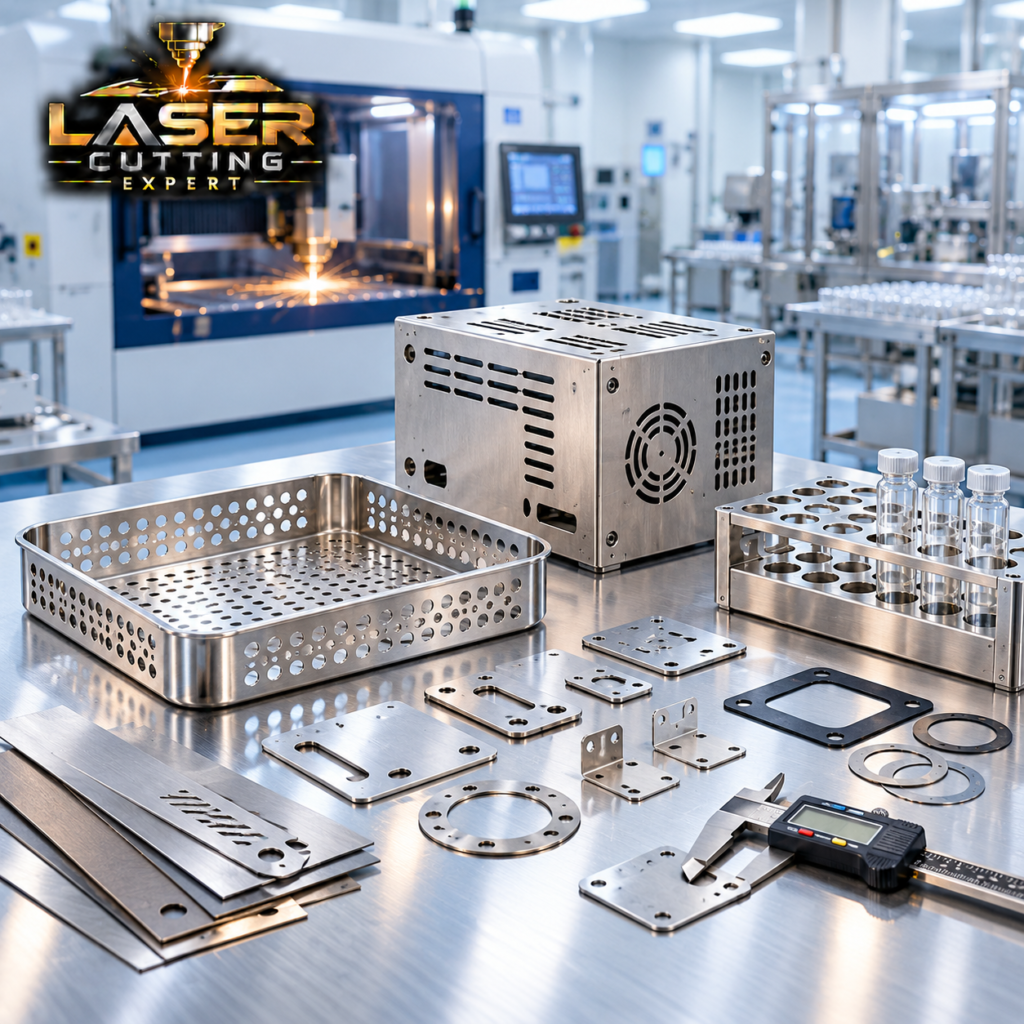
Medical and pharmaceutical manufacturing places unusual demands on a component long before it reaches a hospital, laboratory or production line. Material identity, cleanliness, repeatability, surface condition and documentation can matter just as much as dimensions. Laser Cutting Expert provides medical laser cutting and pharmaceutical laser cutting support from our London production facility for medical device developers, pharmaceutical manufacturers, laboratories, equipment builders, universities, research teams and specialist engineering companies across the UK. Our role can range from prototype plates, housings and fixtures to production equipment panels, stainless steel components and development parts. Regulated or patient contact applications are assessed separately because ordinary fabrication should never be confused with validated medical device manufacturing.
CALL OR EMAIL US FOR PRICES
“Order any time of the day or night and receive your order on the same day in London. You are welcome to visit our laser cutting shop for an instant laser cutting service. On-site collection or free delivery can be arranged. Email us at laser@makergroup.uk for a quick quote or call us on 02036339857 for an instant price”.
Same Day Laser Cutting & Delivery
We can arrange a same day courier delivery with customer live tracking. Or customers can collect from our Laser Cutting Expert shop.

OPEN 24 HOUR
We are open 7 days a week, and you can order at any time. There is no last ordering time and no deadline. We also offer an overnight laser cutting service.

100% Satisfaction
High Quality Laser Cutting & 100% Customer Satisfaction Guarantee. Top-Rated Laser Cutting Company on Google.

Free File Check
We offer a free file check and proof before sending your artwork for laser cutting.
Where Laser Cutting Fits into Regulated Manufacturing
Laser cutting can sit at several points within medical and pharmaceutical production. It may create an early prototype for a new instrument, manufacture a stainless panel for processing equipment, produce a fixture used during assembly or provide a near net blank that receives further precision machining. The required controls depend heavily on what the component actually does. A laboratory equipment cover and an implantable component do not belong in the same manufacturing category. We therefore look at application, material, tolerances, downstream processes and regulatory significance before deciding how a project should be approached.
Medical Laser Cutting
Medical Equipment Manufacturing
Medical laser cutting can support the mechanical parts surrounding diagnostic, laboratory, treatment and healthcare equipment. Suitable applications can include equipment panels, instrument housings, brackets, mounting plates, internal partitions, guards, trays and development components. Stainless steel and aluminium are common possibilities, although the material should always follow the equipment specification. Components intended only as external covers can have very different requirements from parts that contact patients, fluids or sterile environments. Laser Cutting Expert manufactures according to agreed information, while the medical device manufacturer remains responsible for classification, validation, regulatory compliance and the safety of the finished device.
Medical Device Development
New medical equipment often passes through several physical prototypes before a final production design is established. Medical laser cutting can help development teams manufacture enclosure panels, chassis components, mounting plates, brackets and test fixtures without dedicated profile tooling. Engineers can check assembly, access, ergonomics and equipment layout using real parts rather than relying entirely on CAD. Prototype manufacturing does not establish clinical suitability. Materials, electrical systems, biocompatibility, sterilisation and other regulated requirements still need appropriate evaluation by the responsible medical device organisation.
Medical Device Prototypes
Prototype components are useful for determining whether an idea can actually be assembled and used as intended. Medical laser cutting can support proof of concept devices, mechanical test rigs, demonstration housings and development fixtures. A prototype may intentionally use a different material from the final device while geometry is being assessed. That distinction should be documented clearly. A prototype suitable for a design review should not automatically be used in clinical or patient contact applications. Development status and intended use need to remain clear throughout the project.
Medical Equipment Panels
Diagnostic machines, treatment systems and laboratory devices can contain front panels, rear panels, access covers and internal sheet components. Medical laser cutting can create openings for displays, connectors, switches, ventilation and equipment mounting. Panel geometry should be based on actual component data rather than approximate dimensions. Where a panel contributes to electrical protection, ingress protection or EMC performance, the complete enclosure needs validation. Cutting the panel accurately does not establish those ratings by itself.
Medical Equipment Housings
Custom equipment housings can be produced from suitable sheet metal using medical laser cutting as the profiling stage before bending and assembly. Stainless steel, aluminium and coated steel can each be considered depending on the equipment environment. Cleaning chemicals, moisture and repeated handling may influence material and finish. Corners, seams and fixing arrangements can also affect cleanability. Where hygiene is important, the equipment designer should consider the complete construction rather than relying only on stainless material.
Diagnostic Equipment Components
Diagnostic equipment can contain sensor mounts, display panels, covers, equipment brackets and internal mounting plates. Medical laser cutting can manufacture suitable mechanical components from controlled CAD information. Sensor alignment may require greater precision than the enclosure surrounding it, meaning some features may need machining after laser profiling. Electrical and optical systems can also impose clearance requirements. The manufacturing method should therefore follow the function of each feature rather than expecting one process to achieve every requirement.
Medical Instrument Components
Suitable medical laser cutting work can include flat instrument blanks, handles, brackets, guards and development pieces where material, geometry and regulatory requirements are appropriate. Finished surgical instruments, implantable devices and other critical products may require specialist laser micromachining, validated processes, dedicated quality systems and extensive traceability. They should not be treated as ordinary general fabrication work. Where laser cutting is only an early manufacturing stage, later machining, grinding, polishing, passivation and inspection may be necessary before the component reaches its final condition.
Hospital Equipment Components
Beds, carts, equipment stands, diagnostic stations and other hospital systems can contain sheet metal brackets, covers and mounting components. Medical laser cutting can support suitable replacement or newly designed parts according to approved drawings. Equipment used around patients needs careful consideration of sharp edges, trapping points, stability and cleaning. Load bearing or safety critical components require appropriate engineering. Laser Cutting Expert can manufacture the specified geometry but does not certify the completed healthcare equipment.
Medical Trolleys and Carts
Healthcare trolleys can use trays, side panels, equipment brackets, drawer components and mounting plates. Medical laser cutting can produce these parts before bending, welding and finishing. Repeated cleaning may influence material choice and construction. Handles and exposed edges should be comfortable and safe for staff to use. If a trolley carries sensitive equipment or significant loads, stability and wheel arrangement also need consideration. These are finished equipment requirements rather than laser cutting parameters.
Medical Cabinet Components
Storage and equipment cabinets used in healthcare environments can contain stainless steel or coated metal doors, shelves, panels and internal supports. Medical laser cutting can provide accurately profiled components for suitable cabinet systems. Hygiene focused environments may require surfaces that are easy to clean and avoid unnecessary dirt traps. The suitability of a cabinet for sterile storage, medicines or controlled substances depends on the complete cabinet design and operating procedure, not merely the material from which its panels are cut.
Fine Medical Components
Precision Requirements in Medical Manufacturing
Many medical laser cutting projects involve smaller components where kerf, heat input and material thickness become important. Thin sheet can move more easily during processing, while very small holes and narrow bridges can approach the practical limits of a particular process. For true micro scale medical parts, specialist micromachining equipment may be necessary. Manufacturing capability should be matched to the actual tolerance instead of describing every small laser cut component as “micro precision”.
Thin Stainless Steel Components
Stainless steel is widely used around medical and laboratory equipment because appropriate grades can provide corrosion resistance and practical cleaning characteristics. Medical laser cutting can process suitable thin stainless sheet for brackets, covers, shims, instrument parts and equipment components. Thin material needs appropriate handling because it can bend easily after cutting. Surface protection may also matter where cosmetic finish is important. Medical suitability depends on the specific stainless grade, surface condition and intended application rather than stainless steel as a generic category.
Medical Shims
Custom shims can be used to adjust alignment within medical equipment, laboratory instruments and manufacturing fixtures. Medical laser cutting can produce suitable profiles where material thickness and tolerance fit the process. Very thin foil or highly critical alignment applications may require specialist manufacturing or additional inspection. Actual material thickness can vary within specification, so applications relying on precise stack height should consider measured thickness rather than nominal sheet description alone.
Medical Spacers
Flat spacers can help establish controlled gaps between components. Medical laser cutting can manufacture custom metal or suitable non metal spacer profiles. The application determines whether the spacer only performs a mechanical function or also needs electrical insulation, chemical resistance or other properties. A component that physically creates the correct gap should not automatically be assumed suitable for a regulated medical environment without reviewing the material and finished assembly.
Medical Washers
Non standard washers can be produced through medical laser cutting for suitable equipment and development applications. Stainless steel, aluminium and other identified materials can be considered. Where a washer performs a critical load distribution or locking function, its mechanical requirements should be defined by the equipment designer. Very small precision washers may require another manufacturing method depending on thickness, hole diameter and edge quality requirements.
Fine Medical Brackets
Compact brackets can support sensors, screens, pumps, electronic modules and other parts inside medical equipment. Medical laser cutting can create the flat profile before forming. Bend allowance and material direction should be considered if the bracket is folded. Slots can provide adjustment during assembly. Where sensor alignment is critical, machining or locating hardware may be required in addition to the laser cut geometry.
Medical Tubing Applications
Laser Cutting Medical Tubes
Some medical laser cutting applications involve tubular components rather than flat sheet. Tubes can require slots, windows, holes and end profiles. However, medical tubing covers a very wide range, from ordinary equipment framework to tiny implantable device tubing. Fine stent like or catheter related components can require dedicated medical laser micromachining, specialist materials, clean processing and validated quality systems. These should not be presented as equivalent to general tube laser cutting. The exact tube grade, diameter, wall thickness and intended medical function must be established first.
Medical Equipment Tube Frames
Medical carts, equipment stands and support structures can use stainless or mild steel tube frames. Medical laser cutting can support suitable tube profiling for joints, mounting holes and equipment connections. Tube laser cutting can reduce manual drilling and help prepare components for welding. Structural stability, weld quality and safe load capacity remain the responsibility of the finished equipment manufacturer. Surfaces intended for frequent cleaning may also require appropriate finishing after fabrication.
Small Diameter Medical Tubing
Very small diameter tubing can move beyond normal fabrication into specialist micromachining. Medical laser cutting of this type may require dedicated equipment capable of controlling extremely small features and heat affected zones. Material traceability and inspection can also be significant. Laser Cutting Expert assesses such enquiries according to the actual specification and will not represent ordinary tube cutting capability as suitable for implantable or other highly regulated devices without the required specialist manufacturing route.
Pharmaceutical Laser Cutting
Pharmaceutical Manufacturing Equipment
Pharmaceutical laser cutting can support equipment used around medicine production, packaging, laboratory work and process handling. Suitable components can include stainless equipment panels, machine guards, brackets, covers, trays, frames, mounting plates and fabrication profiles. Pharmaceutical production can impose demanding hygiene and contamination control requirements. Component geometry should therefore consider cleanability and access. Laser cutting is one manufacturing stage; welding, grinding, polishing, passivation and validation may all affect whether the final equipment is appropriate for pharmaceutical use.
Pharmaceutical Production Machinery
Tablet, capsule, liquid, powder and packaging operations use specialised machinery containing many fabricated components. Pharmaceutical laser cutting can manufacture suitable machine panels, doors, equipment brackets, covers and structural fabrication parts according to approved drawings. Production machinery needs safe access for cleaning and maintenance. Guarding also needs to prevent unsafe contact with moving parts. Laser Cutting Expert produces specified mechanical components while the machine builder remains responsible for GMP requirements, machinery safety and process validation.
Pharmaceutical Machine Guards
Production equipment can use fixed and removable guards around drives, conveyors, filling equipment and packaging mechanisms. Pharmaceutical laser cutting can create stainless or other suitable guard panels containing ventilation, viewing or access features where appropriate. Opening size should follow the actual machinery risk assessment. Guards should also allow the equipment to be cleaned without encouraging operators to leave protective components removed. Machine safety is determined by the complete guarding system, not by the accuracy of the individual laser cut panel.
Pharmaceutical Equipment Panels
Control panels, side covers and machine enclosures can be manufactured using pharmaceutical laser cutting before folding and finishing. Stainless steel is commonly considered where cleaning and corrosion resistance are important. Surface finish and joint construction can matter as much as the base material. Unnecessary crevices can trap residue. Equipment builders should therefore develop panels around the cleaning regime and process environment rather than choosing stainless steel alone and assuming that automatically creates hygienic equipment.
Pharmaceutical Equipment Brackets
Sensors, motors, guards, pipes and auxiliary systems can require custom mounting brackets. Pharmaceutical laser cutting can produce suitable brackets with holes, slots and folded geometry. Brackets installed near product contact areas may have different hygiene requirements from those located inside a closed machinery base. Material and finish should reflect the actual location. The equipment designer should also consider whether fasteners and adjustment slots create difficult to clean areas.
Pharmaceutical Trays
Suitable stainless sheet can be profiled for trays used around manufacturing, laboratory or equipment applications. Pharmaceutical laser cutting can create the flat blank before bending and welding. If a tray directly contacts pharmaceutical product, its final suitability depends on material grade, weld quality, surface finish, cleaning procedure and process validation. A laser cut stainless blank alone should not be described as pharmaceutical contact compliant. The complete fabrication route needs to match the intended use.
Pharmaceutical Machine Frames
Equipment frames support filling, packaging, inspection and processing machinery. Pharmaceutical laser cutting can provide plates, brackets, gussets and connection components within fabricated frame systems. Tube and sheet components may be combined. Open frame construction can improve cleaning access in some applications, while enclosed bases may be preferred elsewhere. The machine manufacturer should define the hygienic and structural requirements before component production.
Pharmaceutical Processing Areas
Clean Manufacturing Environments
Pharmaceutical facilities often control particles, contamination and cleaning more carefully than ordinary industrial workshops. Pharmaceutical laser cutting can manufacture components that later form part of equipment used within controlled environments, but manufacturing a component does not itself make it cleanroom certified. Cleaning, packaging, handling and installation procedures all matter. If special cleanliness or packaging is required after fabrication, those requirements need to be identified before the production route is agreed.
Cleanroom Equipment Components
Suitable pharmaceutical laser cutting applications can include panels, brackets, equipment covers, workstation components and support plates used within cleanroom equipment. Stainless steel may be selected because appropriate grades and finishes can withstand repeated cleaning. Flat surfaces and accessible joints can simplify maintenance. Cleanroom classification applies to the controlled environment as a system, not to an isolated laser cut component. Finished equipment needs to be assessed within the facility’s contamination control strategy.
Pass Through Equipment Panels
Pharmaceutical and laboratory environments can use pass through boxes between controlled spaces. Pharmaceutical laser cutting can support suitable enclosure panels, door components and mounting plates for equipment manufacturers. Sealing, interlocking, filtration and cleanability are complete system requirements. Laser Cutting Expert can manufacture the mechanical sheet components, but cleanroom performance and validation remain with the pass through equipment manufacturer.
Pharmaceutical Workstation Components
Workstations can require stainless tops, equipment panels, shelving supports and brackets. Pharmaceutical laser cutting can provide suitable profiles before fabrication. Ergonomics and cleanability should both be considered. Exposed edges need appropriate finishing, and equipment surfaces should avoid unnecessary traps where residues can accumulate. The final workstation should be designed around the specific pharmaceutical or laboratory task.
Laboratory Laser Cutting
Laboratory Equipment
Medical and pharmaceutical laboratories frequently use custom test equipment, instrument stands, sample racks and machine housings. Medical laser cutting and pharmaceutical laser cutting can support suitable mechanical components for these systems. Research environments often need one off or small quantities, which fits our no minimum cutting approach. Chemical resistance should be considered where components are exposed to solvents or reagents. A laboratory application does not automatically require medical device certification, but its own safety and containment requirements still need to be understood.
Laboratory Instrument Panels
Custom scientific instruments can require panels for displays, connectors, controls and sensors. Medical laser cutting can create accurate openings from CAD data. The mechanical design should account for cables and equipment behind the panel, not only the visible front components. Instruments working with lasers, radiation, high voltage, pressure or hazardous chemicals may require specialist protection. The enclosure needs to be designed around those hazards.
Laboratory Racks
Tube racks, sample holders and equipment organisers can be manufactured from suitable acrylic, metal or other identified materials. Pharmaceutical laser cutting can create repeated holes and slots for development or laboratory use fixtures. The material should be compatible with the chemicals, cleaning agents and temperatures involved. Autoclave requirements, for example, can rule out materials that would otherwise be perfectly suitable for ordinary room temperature use.
Sample Holders
Research projects can require custom sample holders for experiments and testing. Medical laser cutting can produce suitable flat plates, frames and locating components. The holder’s dimensional accuracy should match the experiment rather than being specified more tightly than necessary. Where optical alignment or very fine positioning is required, laser cut parts can be combined with machined locating features.
Laboratory Templates
Templates can help technicians position samples, labels or components consistently. Pharmaceutical laser cutting can produce suitable reusable templates from acrylic, metal or other compatible materials. Material selection should account for cleaning and chemical exposure. Templates are production aids rather than calibrated measurement devices unless they have been designed, inspected and controlled for that specific purpose.
Pharmaceutical Packaging Equipment
Packaging Line Components
Medicine packaging systems can include conveyors, guides, guards, sensor brackets and equipment panels. Pharmaceutical laser cutting can produce suitable components for packaging machinery manufacturers and maintenance teams. Components near open product or primary packaging may require greater hygiene consideration than parts on the outside of the machine. Production speed and repeated motion can also introduce wear. Material and geometry should follow the actual machine environment.
Blister Packaging Machinery
Blister pack equipment contains forming, sealing, feeding and cutting systems. Pharmaceutical laser cutting can support suitable external panels, guards, mounting plates and non critical fabrication components. Tooling directly responsible for blister formation or sealing may require precision machining and specialist materials beyond general laser cutting. The machine builder should distinguish between ordinary fabricated components and process critical tooling.
Bottle Filling Equipment
Liquid pharmaceutical filling lines can use equipment panels, guards, brackets and support structures. Pharmaceutical laser cutting can provide suitable stainless components for fabrication. Product contact parts require specific hygienic design and validation. Laser cut equipment components outside the product path can still benefit from corrosion resistant materials and accessible construction because filling environments require regular cleaning.
Labelling Machine Components
Labelling systems can contain sensor mounts, guide plates, brackets and protective panels. Pharmaceutical laser cutting can manufacture suitable profiles for these assemblies. Adjustment slots can help position sensors and guides during setup. Moving web and conveyor systems need appropriate guarding. Components should be designed for practical changeover where several bottle or carton sizes are processed on the same machine.
Cartoning Equipment Components
Cartoning machinery can use side panels, guards, mounting plates and fabrication brackets. Pharmaceutical laser cutting can produce suitable parts for equipment builders or maintenance programmes. Packaging machines often operate at high speed, making vibration and fastener security important. Access panels should support maintenance without compromising machine safety during operation.
Medical & Pharmaceutical Enclosures
Stainless Equipment Enclosures
Stainless steel enclosures can be used around medical and pharmaceutical machinery where cleaning and corrosion resistance matter. Medical laser cutting can produce enclosure blanks before bending and welding. Grade, surface finish and fabrication method need to match the environment. Weld discolouration, rough joints and inaccessible crevices can affect cleanability. Stainless steel alone does not automatically create hygienic equipment.
Electrical Enclosures for Medical Equipment
Medical devices and pharmaceutical machines contain control electronics that need suitable protection. Medical laser cutting can manufacture doors, control panels, gland plates and enclosure components according to approved designs. Electrical safety, EMC, ingress protection and medical electrical standards apply at system level. Modifying an existing rated enclosure can affect its original performance, so changes should be reviewed by the responsible equipment manufacturer.
Instrument Housings
Scientific and healthcare instruments can require compact custom housings. Medical laser cutting can produce suitable chassis plates, covers and front panels. Aluminium may be useful for lightweight equipment, while stainless steel can suit more demanding cleaning environments. Ventilation needs to balance cooling against contamination or liquid ingress. The complete instrument design determines which approach is appropriate.
Material Selection
Stainless Steel for Medical Work
Stainless steel is common within medical laser cutting, but the grade should be specified rather than simply requesting “medical stainless”. 304 and 316 family materials have different applications, and more specialised grades exist for particular devices. Surface finish, corrosion resistance, welding and cleaning all matter. If the material is intended for an implant or other critical application, specialist medical material specifications and validated manufacturing controls are required.
316 Stainless Steel
316 and related grades can be used around medical, pharmaceutical and laboratory equipment where improved corrosion resistance is useful. Pharmaceutical laser cutting can process suitable sheet for panels, brackets, trays and fabrication components. The exact grade should follow the application. 316 sheet used in a machine enclosure is not automatically equivalent to certified material intended for a medical implant or pharmaceutical product contact component.
Aluminium
Aluminium can be used in lightweight medical equipment, instrument housings, laboratory fixtures and prototypes. Medical laser cutting can produce suitable panels and mounting components. Aluminium alloy and temper affect strength and forming behaviour. Anodising can provide a finished surface, but chemical compatibility and cleaning requirements should be considered. Aluminium is not appropriate for every pharmaceutical or medical environment simply because it is lightweight.
Titanium
Titanium is associated with medical applications, particularly implants and specialist instruments, but this does not mean ordinary laser cut titanium automatically becomes a medical component. Medical laser cutting involving implantable or safety critical titanium requires appropriate grade traceability, specialist manufacturing, controlled finishing, inspection and regulatory systems. Suitable non implant development parts can be assessed separately. The intended medical function must therefore be declared before manufacturing.
Copper and Brass
Copper and brass can appear within laboratory equipment, electrical systems and specialist devices. Medical laser cutting can assess suitable non patient contact sheet components where the material is appropriate. Copper has useful electrical and thermal properties, while brass can suit certain mechanical and instrument applications. Surface oxidation and cleaning behaviour should be considered. These materials should not be assumed suitable for patient contact without appropriate material assessment.
Acrylic
Acrylic can be useful for laboratory guards, transparent equipment panels, templates and display components. Pharmaceutical laser cutting can create cleanly shaped acrylic components for suitable non critical applications. Acrylic is not automatically suitable for autoclaving, pharmaceutical contact or medical device use. Chemical resistance also varies depending on the cleaning agent. Material selection should follow the environment rather than appearance alone.
Engineering Plastics
Medical and pharmaceutical equipment can use many engineering plastics, but medical laser cutting suitability varies greatly by polymer. Material identity must be confirmed before processing. PVC and chlorine containing materials must not be laser cut because hazardous and corrosive gases can be released. Polycarbonate often produces poor laser cut edges and may be better machined. Acetal/POM can generate hazardous decomposition fumes including formaldehyde and should not be treated as a routine laser material. Mechanical machining may be more appropriate.
Hygienic Design Considerations
Cleanable Geometry
Pharmaceutical laser cutting components may eventually become part of equipment that needs regular cleaning. Flat profiles should therefore be developed with the finished fabrication in mind. Tight corners, inaccessible overlaps and unnecessary cavities can make cleaning more difficult. Laser cutting can produce accurate geometry, but hygienic design depends on bending, welding, fasteners and final assembly as well. The machine designer should consider where residues could collect after the component is installed.
Edge Finishing
Laser cut metal edges may require deburring or additional finishing depending on their final use. Medical laser cutting components handled by staff should not retain unsafe sharp edges. Product contact or high hygiene components can require considerably more controlled finishing. Grinding, polishing, electropolishing or passivation may form part of a specialist downstream process. Required edge and surface conditions should therefore be defined before production.
Weld Preparation
Many pharmaceutical laser cutting parts are later welded into frames, trays, guards or enclosures. Joint geometry can be prepared with later fabrication in mind. Hygienic welding requirements can be significantly different from ordinary structural fabrication. Weld quality, penetration, finishing and documentation may all matter. The laser cut blank is only the starting point of the fabricated component.
Drainage
Equipment exposed to liquids or frequent washdown should avoid unnecessary water traps. Pharmaceutical laser cutting can incorporate openings or geometry that support drainage where specified. However, drainage needs to be considered across the entire assembly. A well positioned hole cannot compensate for a poorly designed folded enclosure that retains liquid elsewhere.
Tooling & Production Aids
Medical Assembly Fixtures
Medical laser cutting can produce suitable fixture plates and assembly aids used during equipment manufacturing. Fixtures can help locate brackets, housings and other components repeatedly. Where the fixture directly controls a critical product dimension, it may require formal inspection and calibration. A simple workshop jig and a validated medical manufacturing fixture should not be treated as the same thing.
Pharmaceutical Assembly Jigs
Pharmaceutical laser cutting can create jigs used to position machine components during fabrication or assembly. Metal, acrylic or plywood may be appropriate depending on whether the jig remains in the workshop or enters a controlled production area. Materials used inside clean environments need to follow the site’s contamination control requirements. A temporary manufacturing aid does not automatically belong in a cleanroom simply because it helped build pharmaceutical equipment.
Inspection Templates
Laser cut templates can provide a quick visual or go/no go check for suitable non critical features. Medical laser cutting can manufacture these from stable sheet materials. Where inspection determines acceptance of a regulated critical characteristic, calibrated metrology should be used according to the manufacturer’s quality system. Laser cut templates are useful production aids but should not be represented as precision calibrated gauges without the appropriate verification.
Equipment Setup Plates
Pharmaceutical machinery can use setup plates or positioning templates during changeover. Pharmaceutical laser cutting can create repeatable hole and slot patterns that help technicians position equipment. Clear identification can be engraved or marked onto each plate. If setup directly influences dosage, fill volume or another critical process parameter, the pharmaceutical manufacturer needs an appropriate validated setup and verification procedure.
CAD & Design Control
Manufacturing from Controlled CAD
Medical laser cutting projects benefit from clear drawing numbers and revision information, particularly when components pass through several development stages. Manufacturing an obsolete revision can create problems even if the part itself is dimensionally perfect. Controlled DXF or CAD files should therefore correspond with the approved drawing. Critical dimensions, materials and finishing requirements should not rely on filenames alone.
Drawing Revisions
Medical and pharmaceutical equipment can remain in production for years while individual components change. Pharmaceutical laser cutting programmes should distinguish clearly between revisions. Hole patterns, sensor positions or access features may change without altering the general appearance of the component. Revision control remains particularly important when replacement parts are manufactured for existing equipment.
Tolerance Definition
Not every dimension on a medical laser cutting component needs the same tolerance. Tight tolerances should be applied where they serve a functional purpose. Excessively tight general tolerances can add unnecessary manufacturing complexity. Critical alignment features may need secondary machining rather than relying entirely on laser cutting. Drawings should communicate which dimensions actually control the function of the part.
Material Specification
A drawing for pharmaceutical laser cutting should identify material properly when grade matters. “Stainless steel” alone may not provide enough information. Thickness, grade, finish and certification requirements should be established. Where traceability is required, it needs to be requested before production rather than after components have been separated from the original stock identification.
Traceability & Documentation
Material Traceability
Some medical laser cutting projects require material certificates or batch traceability. These requirements depend on component classification and the manufacturer’s quality system. They should be established at the quotation and production planning stage. Full traceability cannot simply be reconstructed later if the manufacturing route was not designed to preserve it. General prototypes may not need the same documentation as regulated production components.
Part Identification
Medical and pharmaceutical equipment can contain many visually similar components. Laser engraving, labels or other identification methods can help distinguish part numbers and revisions where appropriate. Identification should not be placed where it affects sealing, cleaning or critical surfaces. The equipment manufacturer should define any mandatory marking or UDI related requirements for regulated medical products.
Inspection Requirements
Medical laser cutting can be followed by dimensional inspection according to the agreed requirement. The appropriate inspection method depends on feature size, tolerance and component function. Safety critical or regulated parts can require formal inspection plans and validated measurement equipment beyond ordinary workshop checks. These requirements need to be identified before manufacturing begins.
Research & Development
Medical Research Projects
Universities, healthcare researchers and engineering teams can use medical laser cutting for experimental equipment, test rigs, sample holders and development components. Our no minimum cutting quantity makes one off work possible. Research status does not remove safety responsibilities. Equipment involving patients, biological materials, radiation, pressure, lasers or hazardous chemicals requires appropriate institutional and technical controls.
Pharmaceutical Research Equipment
Laboratories developing medicines or production processes can require custom equipment panels, racks, holders and experimental fixtures. Pharmaceutical laser cutting can support suitable mechanical components for this work. Chemical exposure, cleaning and containment should be considered when choosing materials. Components intended for use inside controlled laboratory systems need to follow the laboratory’s own procedures.
University Medical Engineering
Biomedical engineering students and university research groups can require prototype housings, test fixtures, brackets and mechanical models. Medical laser cutting can turn suitable CAD files into physical development parts without requiring a production quantity. Student or academic projects intended for clinical use still require the appropriate institutional approvals and regulatory route. Prototype manufacture alone does not provide permission for patient use.
Medical Manufacturing Support
One Off Development Components
We have no minimum cutting quantity, allowing medical laser cutting projects to begin with a single suitable component. This can be useful when checking equipment layout, bracket geometry or enclosure dimensions. Once the design is confirmed, additional components can be produced from the approved revision. A development component should remain clearly separated from validated production stock where the project is regulated.
Small Batch Medical Components
Suitable medical laser cutting can support small production batches for equipment manufacturers, laboratories and specialist engineering companies. Batch requirements should identify material, revision and inspection needs. If components form part of a regulated medical device, the manufacturer’s approved supplier and quality procedures remain applicable. Laser Cutting Expert should not be assumed to provide medical certification unless a specific compliant manufacturing arrangement has been established.
Repeat Pharmaceutical Components
Pharmaceutical laser cutting can support repeated panels, brackets, guards and fabrication components for equipment manufacturers. Controlled CAD helps maintain geometry between batches. Changes should be introduced through revision control rather than informal workshop instructions. Where equipment operates under a validated pharmaceutical process, replacement components may need formal change control from the equipment owner.
Replacement & Maintenance Parts
Medical Equipment Replacement Parts
Older medical equipment can require replacement covers, brackets, trays and other fabricated components. Medical laser cutting can reproduce suitable non critical parts where reliable dimensions and material specifications are available. Safety related replacement components should be approved by the responsible equipment organisation. Reverse engineering should not be used to bypass the original manufacturer’s regulatory responsibilities.
Pharmaceutical Machinery Spares
Production plants can require replacement guards, panels, brackets and machine covers. Pharmaceutical laser cutting can support suitable spares from existing controlled drawings or properly developed replacement CAD. Maintenance teams should confirm the installed machine revision because older and newer machines can look similar while using different components. Product contact and process critical parts require additional consideration.
Same Day Medical Laser Cutting London
Suitable non regulated development, laboratory and equipment components can be considered for same day medical laser cutting from our London workshop where material, approved artwork and production capacity allow. Examples can include prototype panels, brackets, fixtures, equipment covers and development plates. Implantable, patient contact, sterile or other regulated critical components should not be pushed through an ordinary urgent production route simply because the deadline is short. We operate 24/7, including weekends and bank holidays, but appropriate manufacturing controls remain more important than speed.
Same Day Pharmaceutical Laser Cutting London
Suitable equipment panels, brackets, guards, fabrication blanks and maintenance components can be considered for same day pharmaceutical laser cutting in London when the specification is production ready. Material grade, thickness, drawings, quantity and finishing requirements should be provided together. Components requiring specialist hygienic finishing, certification, controlled packaging or validation may need additional production time. Same day cutting refers to suitable fabrication work and should not be interpreted as bypassing pharmaceutical quality requirements.
Medical & Pharmaceutical Laser Cutting Across the UK
Laser Cutting Expert supports medical equipment developers, pharmaceutical machinery manufacturers, laboratories, research organisations and engineering companies throughout the UK from our London production base. Suitable medical laser cutting and pharmaceutical laser cutting work can include prototypes, equipment panels, brackets, guards, fixtures, trays, housings and other engineered sheet components. Our related services CNC Laser Cutting, Fibre Laser Cutting, Tube & Pipe Laser Cutting, Laser Cutting & Bending, Laser Cutting & Finishing and CAD, Design & Prototyping. Specialist regulated components are assessed according to their actual application rather than automatically being treated as ordinary fabrication work.
Important Medical & Pharmaceutical Manufacturing Boundaries
Laser cutting a component accurately does not by itself make that component medical grade, sterile, biocompatible, pharmaceutical compliant or approved for patient contact. Medical laser cutting for implants, surgical devices and other safety critical applications can require specialist material traceability, validated processes, controlled environments, inspection, quality systems and regulatory approval. Pharmaceutical laser cutting components used in product contact or validated process equipment can similarly require specific materials, surface finishes, fabrication methods and documentation. Customers should tell us the intended application at the beginning so that general fabrication is not mistaken for specialist regulated manufacturing.
FAQs About Laser Cutting for Medical & Pharmaceutical
1. What can medical laser cutting be used for?
Medical laser cutting can support suitable equipment panels, brackets, housings, trays, fixtures, shims, mounting plates, laboratory components and development parts.
2. Do you manufacture implantable medical components?
Implantable and other highly regulated medical components require specialist materials, validated manufacturing, traceability, inspection and appropriate quality systems. Such work cannot be treated as ordinary general laser cutting.
3. What is pharmaceutical laser cutting used for?
Pharmaceutical laser cutting can support machine panels, guards, brackets, trays, equipment covers, frame components, laboratory fixtures and suitable pharmaceutical production equipment parts.
4. Can you laser cut stainless steel for medical equipment?
Yes, suitable stainless sheet can be laser cut for medical and laboratory equipment. The required grade, finish and documentation should be specified according to the application.
5. Can you laser cut components for pharmaceutical machinery?
Yes. Suitable pharmaceutical laser cutting can include guards, machine panels, brackets, access covers, mounting plates and fabrication components.
6. Do you make medical prototypes?
Yes. Suitable medical laser cutting can be used for one off prototype housings, brackets, test fixtures and development components. Prototype manufacture does not itself establish clinical or regulatory approval.
7. Can you laser cut medical tubing?
Suitable tube components can be assessed. Very small medical tubing, stent type components and implantable devices can require specialist medical laser micromachining and validated manufacturing systems.
8. Does stainless steel automatically make a component pharmaceutical grade?
No. Material grade, surface finish, welding, cleaning, fabrication, documentation and intended use all affect suitability. Stainless steel alone does not make equipment pharmaceutical compliant.
9. Do you have a minimum quantity for medical or pharmaceutical projects?
No. We have no minimum cutting quantity, so suitable one off development components and small batches can be considered.
10. Can you provide urgent medical and pharmaceutical laser cutting?
Suitable non critical production ready work can be considered for urgent manufacture, including same day London service where capacity allows. Regulated or specialist components still need the appropriate manufacturing controls regardless of deadline.